


 简体中文
简体中文  English (UK)
  Русский
  বাংলা
বাংলা  العربية
  日本語
日本語  한국어
한국어  Magyar
  Norsk nynorsk
  Türkçe
  עִבְרִית
  Español
  Čeština
  Svenska
  Português
  Ελληνικά
  Suomi
Suomi  Nederlands
  Română
  Italiano
  Français
  Polski
  Українська
  Deutsch
  Slovenčina
  Српски језик
  اردو
اردو  Azərbaycan dili
  O‘zbekcha
  አማርኛ
አማርኛ 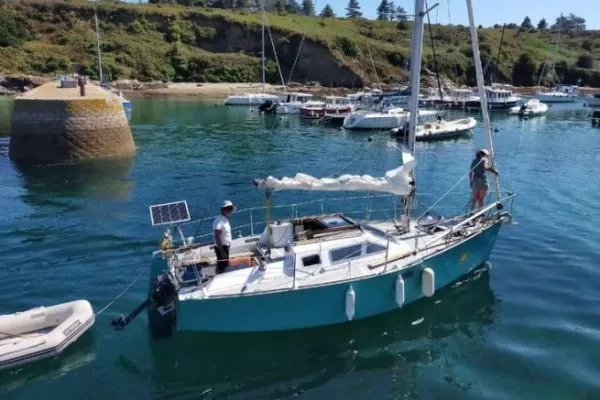 7米、2吨帆船的电动吊舱改装案例研究:从 6 马力舷外机到 3 千瓦 ePropulsion 3.0 Evo">

The 7m, roughly 2-tonne sailboat received a 3 kW ePropulsion 3.0 Evo pod drive mounted on the centerline under the hull, replacing the previous 6 HP outboard; the installation required reinforcement of the sole with 20 mm marine plywood epoxy-bonded between two stringers to distribute the concentrated propulsion loads and protect against grounding impacts.
Pod installation and structural considerations
Installing the pod beneath the hull, longitudinally aligned and parallel to the waterline, optimizes thrust and minimizes parasitic vibration. This configuration concentrates mechanical forces at one fixed point, so local strengthening was mandatory: the floor in the former engine bay was rebuilt on a 20 mm marine-plywood bed, saturated with epoxy to prevent long-term warping and supported by two varangues.
Alignment and mounting details included short, protected cable runs and placing the charger close to the batteries for service access. The entire retrofit, beyond planning, was executed in approximately ten hours of hands-on work.
Installation checklist (at a glance)
- Pod: ePropulsion 3.0 Evo (3 kW), centerline mount
- Hull reinforcement: 20 mm marine plywood between two stringers
- Battery pack: two E60 units (~6 kWh total)
- Battery placement: former engine compartment under companionway
- Charger: mounted above batteries with short wiring
- Epoxy saturation of supports to prevent warping
Batteries and electrical architecture
The electrical system is built around two E60 batteries delivering roughly 6 kWh of usable capacity. The pack sits on the reinforced 20 mm plywood floor and is secured to two varangues. Wiring is routed for minimal length and maximum protection, and the charger occupies an accessible position above the battery bank.
Practical notes: solar input is reserved for auxiliary services, and hydro-generation below 5 knots proved marginal during testing—expect limited replenishment from passage alone.
Power, speed and range — sea-trial data
| Power draw | Speed (knots) | Approx. range |
|---|---|---|
| 1,500 W | 4.3 | ~17 nm (≈4 hours) |
| 3,000 W | ~5.2 (gain ≈0.9 kn) | Range drops significantly |
解释
在 1,500 W the boat reaches near hull speed with good efficiency—about 25% battery capacity per hour. Doubling to 3,000 W yields only a modest speed gain while dramatically reducing range: beyond this point the energy cost per additional knot becomes unfavorable.
Cruising feedback and itinerary implications
Over a week-long cruise from Arradon calling at Hoedic 和 Belle-Ile and returning to the Gulf, the sailboat recorded ~82 miles sailed while motoring only two effective hours (approximately 8 miles). Total battery consumption for the week was roughly 50%, with one hour for harbour manoeuvres and one hour to secure arrival before a tidal reversal—the remainder was under sail.
For coastal touring: the combination of quiet electric propulsion and conservative power sizing supports a sailing-first itinerary, but planners should factor in limited motoring reserves for adverse wind or tidal conditions.
Limitations and recommended redundancy
- Energy reserve risk: strong headwinds or current can exceed stored capacity.
- Backup: carry a small 2,000 W generator for emergency recharging.
- 再生: 水力发电在 5 节以下时很小;不要依赖它进行持续充电。.
电力推进如何重塑巡航体验
电力牵引改变日常生活: 近乎静音,瞬间扭矩实现精准操控,无需车载燃油, ,并减少年度机械维护。对于来访的客人和一日游包船乘客来说,安静地驶入港口以及缺乏震动,能带来更轻松的抵达体验和更适合拍照的体验——请注意,这对于计划举办游艇派对或短途巡航套餐的运营商来说非常重要。在像Pizzicato这样的轻型巡洋舰上,安装是一种有意识的权衡:优先考虑沿海航行,并接受可控的、非过度的电机功率。.
转换不仅仅局限于硬件:它需要重新思考物流——充电策略、港口服务和备用燃料计划——所有这些都直接关系到旅行计划以及运营商可以提供的体验类型。.
在 GetExperience,您可以从经过验证的供应商处以合理的价格预订体验项目。这使您能够做出最明智的决定,免除不必要的开支或失望;该平台的透明凭证确认和安全支付流程使安排定制的岸上服务或量身定制的水上体验变得简单明了。在准备假期时,不要只考虑单一的服务,而是要精心安排一个文化项目——GetExperience 帮助安排当地导游、带有现场导游的博物馆之旅,或为活动提供专属游艇租赁服务,这些都与生态意识巡游完美互补。预订您的行程 GetExperience.com
总而言之,这次改造表明一个 3 千瓦舱 约 6 千瓦时电池容量适合 7 米海岸巡洋舰,航行计划优先考虑航行时间和短时推进。 这样可以实现更安静、更清洁的航行,并为旅游经营者和私人船长带来实际利益。 在计划海岸跳跃旅行时,请考虑能源、冗余和行程之间的平衡:精心选择的系统能够带来难忘的旅行体验——无论您是组织探险活动、游艇派对还是环保野生动物园——并且可以与精选产品相结合,如带有现场导游的博物馆之旅、邮轮套餐、互动式在线文化工作坊或用于活动的专属游艇租赁。.