


 Українська
  English (UK)
  Русский
  বাংলা
বাংলা  العربية
  日本語
日本語  한국어
한국어  Magyar
  Norsk nynorsk
  Türkçe
  עִבְרִית
  Español
  Čeština
  Svenska
  Português
  Ελληνικά
  Suomi
Suomi  Nederlands
  Română
  Italiano
  Français
  Polski
  Deutsch
  简体中文
简体中文  Slovenčina
  Српски језик
  اردو
اردو  Azərbaycan dili
  O‘zbekcha
  አማርኛ
አማርኛ 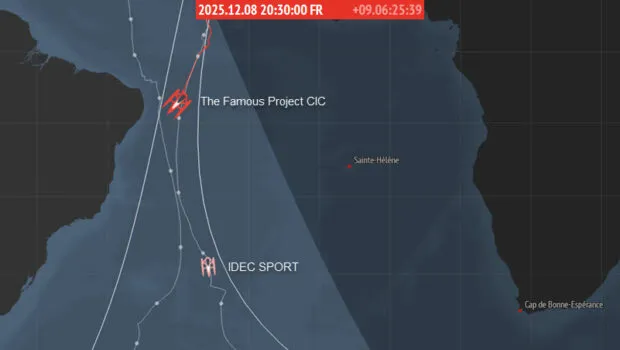 An all-women team in pursuit of a Jules Verne Trophy benchmark time during circumnavigation attempt">

As of late on 8 December the The Famous Project CIC crew was logged in the South Atlantic, approaching the eastern tip of Brazil and trailing Francis Joyon’s IDEC SPORT reference pace by 1245 nautical miles, a decisive logistical gap for any Jules Verne attempt.
Current position and logistical considerations
Weather routing and start-window selection are critical for any non-stop circumnavigation. Forecast models routinely provide reliable guidance only to the equator; beyond that, projections rely on ensemble forecasts and oceanic climatology. For The Famous Project CIC, being approximately 1,000–1,245 nm behind the 2017 IDEC SPORT splits meant adjusting sail plans and crew rotation to manage fatigue, consumables and routing through the Southern Ocean’s high-pressure systems and roaring westerlies.
Rules that shape the route
The Jules Verne Trophy requires a Non-stop, unaided circumnavigation starting and finishing on the line between Le Créac’h Lighthouse (Ushant) and Lizard Point. The course passes the three Capes (Good Hope, Leeuwin, Horn) and covers a minimum of 21,600 nautical miles. That regulatory framework determines provisioning, safety equipment lists and the strategic use of weather windows.
Operational checklist at a glance
- Start/Finish line: Le Créac'h Lighthouse - Lizard Point
- Course: Non-stop via the three Capes
- Minimum distance: 21,600 nm
- Ratification: World Sailing Speed Record Council
- Key risk areas: Southern Ocean gyres, iceberg zones, cyclone risk seasons
The crew and on-board roles
The Famous Project CIC sailed with an eight-woman crew, combining experience in offshore skippers and young performance sailors. Crew makeup matters for sleep systems, sail changes and emergency responses—especially in extreme latitudes.
| Role | Name (age) | Nationality |
|---|---|---|
| Captain | Alexia Barrier (46) | Франція |
| First Officer | Dee Caffari (53) | Great Britain |
| Watch leader / Navigator | Annemieke Bes (47) | Нідерланди |
| Trimmer / Sail tech | Rebecca “Bex” Gmuer (25) | Switzerland / New Zealand |
| Deck/Systems | Deborah “Debs” Blair (23) | Great Britain |
| Boat captain | Molly LaPointe (30) | USA / Italy |
| Tactician | Tamara “Xiquita” Echegoyen (41) | Іспанія |
| Systems / Communications | Stacey Jackson (42) | Австралія |
Reference splits and the benchmark to beat
The current record to beat is 40 days 23 hours 30 minutes 30 seconds, set by Francis Joyon aboard IDEC SPORT in January 2017. Historical split references provide tactical targets during each leg:
- Ushant–Equator: 4d 20h 07′ (Spindrift 2, 2019 reference)
- Equator–Cape Agulhas: 6d 08h 55′ (Banque Populaire V, 2012)
- Cape Agulhas–Cape Leeuwin: 4d 09h 32′ (IDEC SPORT, 2017)
- Cape Leeuwin–Cape Horn: 9d 08h 46′ (IDEC SPORT, 2017)
- Cape Horn–Equator: 7d 04h 27′ (Banque Populaire V, 2012)
- Equator–Ushant: 5d 19h 21′ (IDEC SPORT, 2017)
How this effort links to tourism and local economies
High-profile offshore attempts drive interest in coastal destinations, yacht charters and sailing experiences. Ports that serve as stopover or staking points for logistics — even though the Jules Verne is non-stop — see increased demand for related services like charter planning, luxury yacht charters for events and marina support. Onshore tourism benefits from media coverage and the growth of adventure sailing as a leisure product.
Implications for experience providers
Operators can leverage race attention to promote вечірки на яхтах, ексклюзивні чартери яхт, and guided coastal excursions. Platforms that consolidate offers and allow secure booking help convert spectator interest into real bookings.
For travellers and tour operators alike, following an attempt such as Alexia Barrier’s offers practical lessons in provisioning, route risk management and crew planning—insights that feed into organising adventure trips, cruise packages and eco-friendly wildlife safaris on a commercial scale.
Highlights: the crew’s position (1245 nm behind the 2017 pace), the operational constraints of Southern Ocean routing, and the aim to establish the first all-female reference time are all compelling. Still, even the most thorough updates and honest reviews can’t replace first-hand experience. On GetExperience, you book your experience from verified providers at reasonable prices; payments are secure and a voucher confirmation is issued after booking, and you can submit tailored requests for tours or excursions to receive offers that fit your preferences. This transparency and convenience help you avoid unnecessary expenses and disappointment—Book now GetExperience.com
In summary: operational timing, weather routing and crew composition were decisive in The Famous Project CIC’s Jules Verne push, leaving them behind the IDEC SPORT reference pace but well positioned to set an all-woman benchmark. The episode highlights logistics of global passage-making and its knock-on effects for travel experiences, adventure activities, yacht parties, cruise packages, safari tours, museum tours with live guides, online virtual tours, and even niche offerings such as beginner esports coaching sessions or professional esports training programmes. For travellers seeking interactive online cultural workshops, luxury adventure travel experiences, adventure rafting trips for beginners, eco-friendly wildlife safaris or exclusive yacht charters for events, the practical lessons from high-performance offshore racing remain inspiring and instructive.