


 Français
  English (UK)
  Русский
  বাংলা
বাংলা  العربية
  日本語
日本語  한국어
한국어  Magyar
  Norsk nynorsk
  Türkçe
  עִבְרִית
  Español
  Čeština
  Svenska
  Português
  Ελληνικά
  Suomi
Suomi  Nederlands
  Română
  Italiano
  Polski
  Українська
  Deutsch
  简体中文
简体中文  Slovenčina
  Српски језик
  اردو
اردو  Azərbaycan dili
  O‘zbekcha
  አማርኛ
አማርኛ 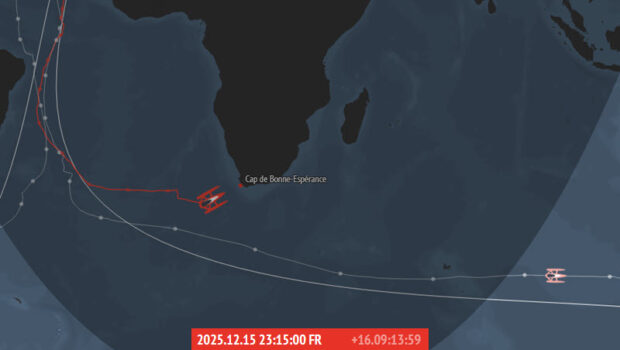 Halyard failure on IDEC SPORT forces all-women crew to reassess record attempt">

Immediate operational impact: halyard, reefing and routing
A failing main halyard hook on the 103-foot trimaran IDEC SPORT is preventing the mainsail from being hoisted beyond the second reef, which directly limits sail area, reduces sustained average speed and forces conservative routing decisions to protect rigging during the Jules Verne Trophy run. That mechanical constraint converted an initial push for the overall Jules Verne record into a secondary objective: setting a benchmark reference time sailed by an all-women crew.
Why a stop for repairs isn’t an option
The Jules Verne Trophy regulations require a non-stop, unassisted circumnavigation via the three Capes. Any port stop for repairs would void the attempt under those rules, so the operational choice faced by the team was binary: attempt at reduced pace while remaining non-stop, or retire and seek repairs ashore. Tracker positions showed an initial decision to press on, then a heading change toward Cape Town the following day—indicative of weighing risk, weather windows and spares on board.
Current tracker and pacing
As of the latest update on December 17 (1400 UTC), IDEC SPORT was proceeding past Cape Town into the Indian Ocean but trailing the standing record by roughly 3,700 nautical miles. Earlier positions had the boat over 3,100 nm behind record pace while positioned about 380 nm southwest of the Cape. These distances translate to required average speed differentials that make catching the 2017 benchmark highly unlikely without significant rig or routing changes.
Crew manifest and roles
The all-women crew aboard this attempt includes:
- Alexia Barrier (46) – France – Captain
- Dee Caffari (53) – Great Britain – First Officer
- Annemieke Bes (47) – Netherlands
- Rebecca “Bex” Gmuer (25) – Switzerland/New Zealand
- Deborah “Debs” Blair (23) – Great Britain
- Molly LaPointe (30) – USA/Italy – Boat Captain
- Tamara “Xiquita” Echegoyen (41) – Spain
- Stacey Jackson (42) – Australia
Jules Verne Trophy: rules, distances and the benchmark
The Jules Verne Trophy is certified by the World Sailing Speed Record Council and stipulates a start/finish line between Le Créac’h Lighthouse (Ushant) and Lizard Point (England), a non-stop route via the three Capes and a minimum distance of 21 600 milles nautiques. The time to beat remains the 2017 IDEC SPORT run under Francis Joyon: 40 jours, 23 heures, 30 minutes et 30 secondes, an average of 21.96 knots.
Record facts at a glance
| Paramètre | Détail |
|---|---|
| Start/Finish line | Créac’h (Ushant) – Lizard Point (England) |
| Course type | Non-stop, unassisted via Good Hope, Leeuwin, Horn |
| Minimum distance | 21,600 nm (40,000 km) |
| Record time | 40d 23h 30m 30s (IDEC SPORT, 2017) |
| Ratification | Conseil Mondial des Records de Vitesse à la Voile |
Historical holders of the Jules Verne Trophy
Since the first winning effort in 1993, nine multihull crews have held the trophy. The progression shows technological and tactical gains in offshore multihull sailing, particularly in average speeds on ocean legs.
- 2017 – Francis Joyon / IDEC SPORT – 40:23:30:30
- 2012 – Loïck Peyron / Banque Populaire V – 45:13:42:53
- 2010 – Franck Cammas / Groupama 3 – 48:07:44:52
- 2005 – Bruno Peyron / Orange II – 50:16:20:04
- 2004 – Olivier De Kersauson / Geronimo – 63:13:59:46
- 2002 – Bruno Peyron / Orange – 64:08:37:24
- 1997 – Olivier De Kersauson / Sport-Elec – 71:14:22:08
- 1994 – Peter Blake, Robin Knox-Johnston / Enza New Zealand – 74:22:17:22
- 1993 – Bruno Peyron / Commodore Explorer – 79:06:15:56
Logistics, safety and tourism intersections
Operational setbacks like a halyard failure illustrate how supply-chain elements—spare parts, on-board redundancy, communications and weather-routing services—affect high-end offshore challenges and, indirectly, coastal tourism economies. Ports such as Cape Town or Ushant that appear in these runs see increased visitor interest: spectators, museum visits and shore-side hospitality all benefit when historic attempts pass nearby.
For travelers curious to combine coastal sailing lore with local experiences, curated offerings—ranging from museum tours with live guides to exclusive yacht charters for events—create opportunities to connect race narratives to onshore culture. Platforms that allow secure online payments, voucher confirmations and tailored tour requests make planning these themed visits straightforward.
Key takeaways and the value of firsthand experience: the technical failure aboard IDEC SPORT underlines the razor-thin margins in record attempts and highlights the courage and seamanship of the all-women crew. Still, even the clearest updates and most detailed analyses can’t substitute for being there in person; personal travel experiences reveal nuance that reports miss. On GetExperience, you book verified providers, pay securely with voucher confirmation, and can submit requests for tailored tours—helping you choose convenient, affordable options from an extensive range of experiences in ports like Cape Town, Ushant and beyond. Book now GetExperience.com
In summary, the halyard malfunction on IDEC SPORT shifted The Famous Project CIC’s plan from chasing the overall Jules Verne Trophy to attempting an all-women crew reference time; the crew composition, the regulatory non-stop requirement and the sheer distances involved framed every operational decision. For travelers and sailing fans, the episode ties into broader travel experiences and adventure activities—whether you seek luxury adventure travel experiences, eco-friendly wildlife safaris, yacht parties, cruise packages, safari tours, museum tours with live guides, interactive online cultural workshops, online virtual tours, or even beginner esports coaching sessions and professional esports training programs as alternative entertainment. Adventure rafting trips for beginners, exclusive yacht charters for events and other immersive options round out the choices for those who want to turn race-watching into a memorable trip.