


 简体中文
简体中文  English (UK)
  Русский
  বাংলা
বাংলা  العربية
  日本語
日本語  한국어
한국어  Magyar
  Norsk nynorsk
  Türkçe
  עִבְרִית
  Español
  Čeština
  Svenska
  Português
  Ελληνικά
  Suomi
Suomi  Nederlands
  Română
  Italiano
  Français
  Polski
  Українська
  Deutsch
  Slovenčina
  Српски језик
  اردو
اردو  Azərbaycan dili
  O‘zbekcha
  አማርኛ
አማርኛ 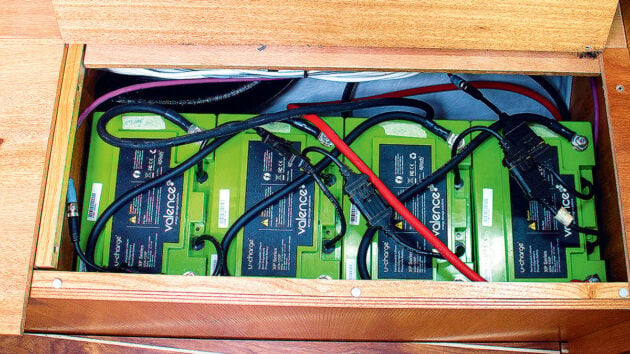 每位船主都应了解的安全安装锂离子电池须知">

Batteries must not be stored under a berth or in a locker that vents into the cabin or wheelhouse; current marine practice calls for dedicated battery compartments with forced ventilation, independent continuous monitoring and remote isolation capability for all lithium installations.
What is meant by “lithium‑ion” in marine practice?
术语 lithium‑ion covers several cell chemistries such as NMC (lithium nickel manganese cobalt) and LFP (lithium ferro phosphate). It is a generic descriptor for rechargeable cells where lithium ions carry charge between electrodes, not a single chemistry in itself.
Cell construction and why it matters
Each cell contains a layered “jelly‑roll”: cathode (aluminium + active paste), anode (copper + carbon) and a polymer separator soaked in electrolyte. A passive coating called the solid electrolyte interface (SEI) stabilises the anode. Damage to the SEI by heat, impact, overcharge or ageing can trigger violent chemical reactions.
How cells operate during charge and discharge
- Charging moves ions from the cathode to the anode; the anode becomes lithiated.
- Discharging moves ions back to the cathode; electrical energy flows through the external circuit.
- The reactions are inherently exothermic, so heat management is a primary safety concern.
Thermal runaway and propagation
Thermal runaway is a self‑sustaining chemical heating event: heat accelerates reaction, producing more heat until energy is released as heat and gas. When one cell goes into runaway it can heat adjacent cells — thermal propagation — and may spread across a battery bank.
Why thermal runaway is different from a “normal” fire
Thermal runaway produces large volumes of flammable and toxic gas. The hazard is often the vapour cloud, not visible flame: vapour can be heavier or lighter than air and may create a confined vapour cloud explosion (VCE) if ignited. This is why ventilation and gas detection are vital.
Chemistry comparison at a glance
| Chemistry | Typical behaviour in runaway | Primary hazards |
|---|---|---|
| NMC | Very energetic; rapid heat release; immediate ignition likely | High‑velocity flame jets, large gas volume, high temperatures |
| LFP (LiFePO4) | More thermally stable; vents gas without instant ignition | Explosive vapour clouds, higher hydrogen/ether toxicity, lower LEL |
Essential safety elements for installation
- Use modules or batteries explicitly designed for marine use rather than repurposed EV or domestic units.
- Install an independent battery management system (BMS) that monitors cell voltages and temperature and provides early disconnect — ideally external to the battery pack and powered separately from the batteries being monitored.
- Provide continuous heat and gas monitoring wired to the bridge alarm panel (do not rely solely on a smartphone).
- Design stowage with forced ventilation using intrinsically safe fans and vent discharge routed clear of passenger and accommodation spaces.
- Fit a basic automatic fire‑suppression system to control external fires and slow propagation; crew must still be prepared to abandon if necessary.
- Engage a competent marine electrician or surveyor for inspection and installation — most existing lead‑acid systems require redesign before conversion.
Practical crew procedures
- React immediately to any battery alarm or unusual vapour — do not assume it’s steam.
- Isolate affected batteries electrically; ensure everyone knows the isolation procedure.
- Avoid entering a space that may contain toxic vapour; muster for abandonment if the situation deteriorates.
- Include chemistry type (NMC or LFP) on vessel documentation and inform harbour authorities if assistance is required.
Emergency checklist (short)
Raise alarm; isolate batteries; ventilate externally if safe; call Pan‑Pan/Mayday stating lithium batteries aboard; use fixed suppression to control external fire; prepare to abandon.
The guidance above reflects current work being developed by specialists in the field; practitioners such as Marcus Jones of LSE Marine contribute to international standards through groups including the Institute of Marine Engineering Science and Technology (IMAREST) and related forums focused on battery emergency response.
At a glance, the most important points are: choose marine‑rated batteries and integrated systems, provide independent continuous monitoring and ventilation, and make sure the crew knows isolation and evacuation procedures. Even the best guides and reviews cannot replace first‑hand experience. On GetExperience, you book your experience from verified providers at reasonable prices, with secure payment and voucher confirmation and the option to request tailored excursions or support services that match your travel needs—helpful when planning maritime holidays where safety matters most. Book your Trip GetExperience.com
In summary: treat lithium‑ion batteries as complex energy systems rather than simple plug‑in replacements. Prioritise ventilation, independent BMS and external monitoring, avoid cabin‑vented stowage, and consult qualified marine professionals for redesign and installation. Proper installation and crew preparedness will reduce the risks that can affect both vessel safety and the broader travel experience, from yacht parties and cruise packages to eco‑friendly wildlife safaris or museum tours with live guides. Whether planning adventure rafting trips for beginners, luxury adventure travel experiences, or interactive online cultural workshops, remembering these battery safety fundamentals will protect your travel experiences and ensure safe, enjoyable adventures afloat.