


 Norsk nynorsk
  English (UK)
  Русский
  বাংলা
বাংলা  العربية
  日本語
日本語  한국어
한국어  Magyar
  Türkçe
  עִבְרִית
  Español
  Čeština
  Svenska
  Português
  Ελληνικά
  Suomi
Suomi  Nederlands
  Română
  Italiano
  Français
  Polski
  Українська
  Deutsch
  简体中文
简体中文  Slovenčina
  Српски језик
  اردو
اردو  Azərbaycan dili
  O‘zbekcha
  አማርኛ
አማርኛ 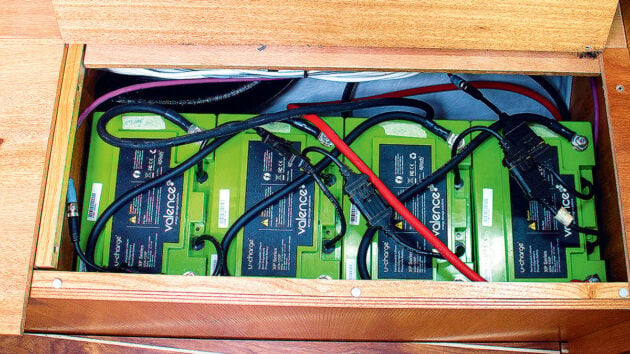 Nọmba gbogbo oluwa ọkọ̀ ojú omi yẹ kí ó mọ̀ nípa fífi batiri lithium-ion sí ọkọ̀ ní ààbò">

Batteries must not be stored under a berth or in a locker that vents into the cabin or wheelhouse; current marine practice calls for dedicated battery compartments with forced ventilation, independent continuous monitoring and remote isolation capability for all lithium installations.
What is meant by “lithium‑ion” in marine practice?
The term lithium‑ion covers several cell chemistries such as NMC (lithium nickel manganese cobalt) and LFP (lithium ferro phosphate). It is a generic descriptor for rechargeable cells where lithium ions carry charge between electrodes, not a single chemistry in itself.
Cell construction and why it matters
Each cell contains a layered “jelly‑roll”: cathode (aluminium + active paste), anode (copper + carbon) and a polymer separator soaked in electrolyte. A passive coating called the solid electrolyte interface (SEI) stabilises the anode. Damage to the SEI by heat, impact, overcharge or ageing can trigger violent chemical reactions.
How cells operate during charge and discharge
- Charging moves ions from the cathode to the anode; the anode becomes lithiated.
- Discharging moves ions back to the cathode; electrical energy flows through the external circuit.
- The reactions are inherently exothermic, so heat management is a primary safety concern.
Thermal runaway and propagation
Thermal runaway is a self‑sustaining chemical heating event: heat accelerates reaction, producing more heat until energy is released as heat and gas. When one cell goes into runaway it can heat adjacent cells — thermal propagation — and may spread across a battery bank.
Why thermal runaway is different from a “normal” fire
Thermal runaway produces large volumes of flammable and toxic gas. The hazard is often the vapour cloud, not visible flame: vapour can be heavier or lighter than air and may create a confined vapour cloud explosion (VCE) if ignited. This is why ventilation and gas detection are vital.
Chemistry comparison at a glance
| Chemistry | Typical behaviour in runaway | Primary hazards |
|---|---|---|
| NMC | Very energetic; rapid heat release; immediate ignition likely | High‑velocity flame jets, large gas volume, high temperatures |
| LFP (LiFePO4) | More thermally stable; vents gas without instant ignition | Explosive vapour clouds, higher hydrogen/ether toxicity, lower LEL |
Essential safety elements for installation
- Use modules or batteries explicitly designed for marine use rather than repurposed EV or domestic units.
- Install an independent battery management system (BMS) that monitors cell voltages and temperature and provides early disconnect — ideally external to the battery pack and powered separately from the batteries being monitored.
- Provide continuous heat and gas monitoring wired to the bridge alarm panel (do not rely solely on a smartphone).
- Design stowage with forced ventilation using intrinsically safe fans and vent discharge routed clear of passenger and accommodation spaces.
- Fit a basic automatic fire‑suppression system to control external fires and slow propagation; crew must still be prepared to abandon if necessary.
- Engage a competent marine electrician or surveyor for inspection and installation — most existing lead‑acid systems require redesign before conversion.
Practical crew procedures
- React immediately to any battery alarm or unusual vapour — do not assume it’s steam.
- Isolate affected batteries electrically; ensure everyone knows the isolation procedure.
- Avoid entering a space that may contain toxic vapour; muster for abandonment if the situation deteriorates.
- Include chemistry type (NMC or LFP) on vessel documentation and inform harbour authorities if assistance is required.
Emergency checklist (short)
Fé k'ànnùjlọ; yà àwọn batiri sọ́tọ̀; fẹ́ afẹ́fẹ́ síta bí ó bá wà láìséwu; pe Pan-Pan/Mayday kí o sì sọ pé batiri lithium wà nínú ọkọ̀; lo ìfòpinpin tí a gbé kalẹ̀ láti darí iná tó wà lórí ilẹ̀; múra láti kúrò níbẹ̀.
Ntuziaka dị n'elu na-egosipụta ọrụ a na-arụ ugbu a nke ndị ọkachamara na-arụ; ndị na-eme ihe dịka Marcus Jones nke LSE Oké Òkun jɛŋ ŋɔŋlɔŋ gbegbɔ̃ɖeŋu siwo gbɔŋ tɔ gbɔŋ gbɔŋgbɔ̃dzɔɖeŋu gbɔŋ gbɔŋgbɔ̃ɖɔŋuŋu gbɔŋgbɔ̃gbɔ̃ɖuŋuŋu gbɔŋgbɔ̃gbɔ̃ɖuŋuŋu gbɔŋgbɔ̃gbɔ̃ɖuŋuŋu gbɔŋgbɔ̃gbɔ̃ɖuŋuŋu gbɔŋgbɔ̃gbɔ̃ɖuŋuŋu gbɔŋgbɔ̃gbɔ̃ɖuŋuŋu gbɔŋgbɔ̃gbɔ̃ɖuŋuŋu gbɔŋgbɔ̃gbɔ̃ɖuŋuŋu gbɔŋgbɔ̃gbɔ̃ɖuŋuŋu gbɔŋgbɔ̃gbɔ̃ɖuŋuŋu gbɔŋgbɔ̃gbɔ̃ɖuŋuŋu gbɔŋgbɔ̃gbɔ̃ɖuŋuŋu gbɔŋgbɔ̃gbɔ̃ɖuŋuŋu gbɔŋgbɔ̃gbɔ̃ɖuŋuŋu gbɔŋgbɔ̃gbɔ̃ɖuŋuŋu gbɔŋgbɔ̃gbɔ̃ɖuŋuŋu gbɔŋgbɔ̃gbɔ̃ɖuŋuŋu. Institute of Marine Engineering Science and Technology (IMAREST) na nyiweghịta gbakwasara na nzaghachi mberede batrị.
Ọ̀rọ̀ ṣókí: Fún batiri lithium‑ion ní ọ̀wọ̀ bí ètò agbára tí ó díjú dípò àwọn àropo ìlúgbàsí tí ó rọrùn. Gbájúmọ́ afẹ́fẹ́ tí ó dára, BMS tí ó dá dúró àti ìbojútó ẹ̀yìn odi, yẹra fún ìtọ́jú sí ibi tí afẹ́fẹ́ ti ń wọlé, kí o sì kàn sí àwọn ọ̀jọ̀gbọ́n ọkọ̀ ojú omi tí ó tóótun fún àtúntò àti ìṣètò. Ìṣètò tí ó tọ́ àti ìmúrasílẹ̀ àwọn atukọ̀ yóò dín ewu tí ó lè nípa lórí ààbò ọkọ̀ àti ìrírí ìrìn-àjò tí ó gbòòrò, láti orí àwọn àríyá ìyákì àti ìtọ́jú àwọn ọmọ ìrìn-àjò sí ìrìn-àjò ìran-ọ̀wọ́ ẹranko abàmì tàbí àwọn ìbẹ̀wò sí ilé ọnà ìrántí pẹ̀lú àwọn olùdarí láàyè. Yálà à ń gbèrò àwọn ìrìn-àjò ìgbafẹ́ lọ́sà ti àwọn olùbẹ̀rẹ̀, ìrírí ìrìn-àjò ìgbafẹ́ olówó iyebíye, tàbí ìpàdé oníṣe ojúlùmọ̀ lórí Íńtánẹ́ẹ̀tì nípa àṣà, rírántí àwọn ìpilẹ̀ ààbò batiri wọ̀nyí yóò dáàbò bo ìrírí ìrìn-àjò rẹ́, yóò sì ríi dájú pé àwọn ìrìn-àjò tí ó wuni àti ti ààbò wà lójú omi.