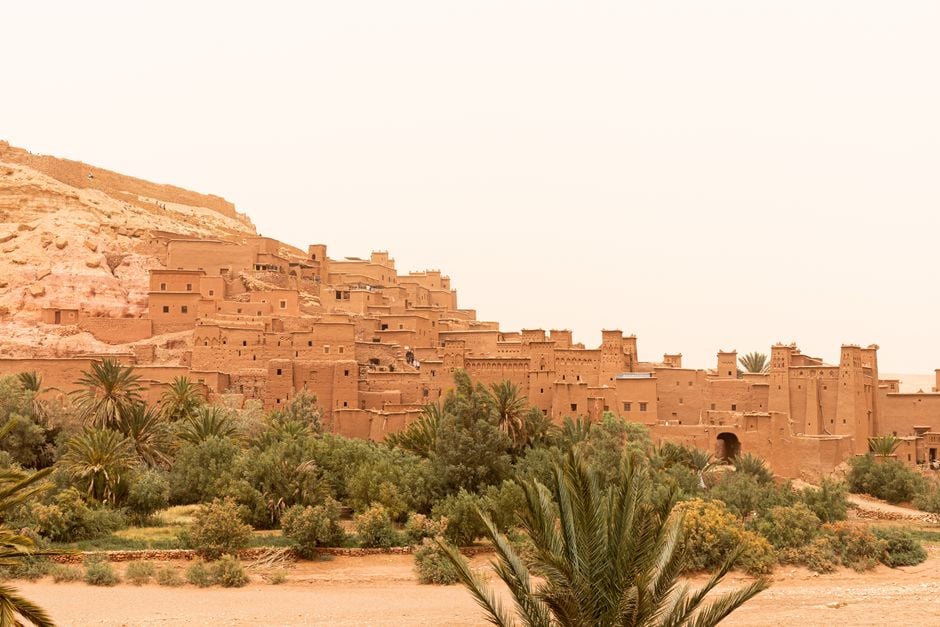
Christopher Nolan shot The Odyssey over 91 days on a new 70 mm IMAX camera system, and almost none of it happened where Homer put it. Troy is in Morocco. Ithaca is in Sicily. The underworld is a headland in Iceland. If you want to stand where the film was made, you need the production map, not the myth map — and the two barely overlap.
This guide lists every confirmed location, what was shot there, and how you actually get to it: nearest airport, approximate travel time from it, and the months when the trip works. Where we have a detailed guide to the area, it is linked in the text.
The production map at a glance
| In the film | Filmed at | Nearest airport | Best months |
|---|---|---|---|
| Troy | Ksar of Aït Benhaddou, Morocco | Marrakech (RAK) | Mar–May, Sep–Nov |
| The shore the fleet leaves from | Essaouira, Morocco | Essaouira (ESU) or Marrakech (RAK) | Apr–Oct |
| Ithaca | Favignana, Egadi Islands, Sicily | Trapani (TPS) | May–Jun, Sep |
| The open sea | Aeolian Islands, Sicily | Catania (CTA) | May–Jun, Sep |
| Island of the Cyclopes | Voidokilia Beach and Nestor’s Cave, Messenia | Kalamata (KLX) | Apr–Jun, Sep–Oct |
| Palace of Menelaus and Helen | Methoni Castle, Messenia | Kalamata (KLX) | Apr–Jun, Sep–Oct |
| Fortress above the isthmus | Acrocorinth, Corinthia | Athens (ATH) | Apr–Jun, Sep–Oct |
| Hades | Hjörleifshöfði, south Iceland | Keflavík (KEF) | Jun–Aug for road access |
| Battle with the giants | Culbin Forest, Findlater Castle, Burghead — Moray Firth coast | Inverness (INV) or Aberdeen (ABZ) | May–Sep |
Two more sites carry no visitor value: the water sequences were completed in tanks on Malta, and interiors were finished on a Los Angeles stage. Everything else on this list is a place you can walk into.
Troy: the Ksar of Aït Benhaddou, Morocco
The walled city that opens the story is a fortified village of earth and straw on the old caravan road between the Sahara and Marrakech. The production worked in Morocco in February and March 2025, when the light is low and the inland heat has not arrived.
Getting there is a mountain drive, not a transfer. From Marrakech the road climbs the Tizi n’Tichka pass at roughly 2,260 m and drops onto the southern side of the High Atlas; allow around four hours each way for the 180 km, and more if you stop at the pass. Ouarzazate, the town that has served North African film production for decades, sits about half an hour further east and has its own airport.
How to use Marrakech as the base
Most visitors sleep in Marrakech and treat Aït Benhaddou as a long day out, or break the journey with a night on the far side of the pass. If you are building the city half of the trip, our guide to Marrakech attractions covers the medina and the practical basics, our round-up of Marrakech museums is the one to read if you want indoor hours during the hottest part of the day, and our walk through the gardens and monuments covers the quieter northern quarter.
One planning note that matters more than any of the above: the drive over the Atlas is the reason to leave early. Coaches and tour convoys reach the ksar in the middle of the day, and the earth walls photograph badly in flat overhead light. First light and the last hour before sunset are when the place looks like it does on screen.
The shore of departure: Essaouira, Morocco
The beaches where the ships put to sea are on the Atlantic coast, about 175 km west of Marrakech — two and a half to three hours by road, or a short flight into Essaouira-Mogador. The wind that makes this coast a kitesurfing centre is the same wind that gives the film’s sailing scenes their weather.
The beach south of the medina runs for kilometres and is wide enough at low tide to ride on, which is how a lot of visitors see it. Our three-hour riding route out of Essaouira covers the stretch of sand, the argan forest behind it and the dunes at the far end, and it is the most direct way to cover the same coastline the production used.
Essaouira is also the one Moroccan location on this list that is comfortable in July and August. The Atlantic keeps it fifteen degrees cooler than the interior; the trade-off is fog on summer mornings.
Ithaca on screen: Favignana, Sicily
Odysseus’s home island is not the Greek Ithaca. It is Favignana, the largest of the Egadi Islands off the west coast of Sicily, with the Castello di Santa Caterina on the island’s high point standing in for the fortress above the harbour.
Favignana is a hydrofoil crossing of about half an hour from Trapani, whose airport is a twenty-minute drive from the port. The island is small, flat on its eastern half and steep on its western one, and it is normally seen by bicycle. Ferry frequency collapses between November and March, which is the practical reason to go in late spring or September rather than in winter.
And the real Ithaca
The Ionian island that Homer actually named is a separate trip, reached by ferry from Kefalonia or from Astakos on the mainland, and it is worth doing on its own terms rather than as a film pilgrimage. Our guide to Ithaca covers the harbours, the walks and the sites that the island itself claims — a useful counterweight if you have just watched a Sicilian island play the part.
The open sea: the Aeolian Islands
The sailing and storm sequences were shot around the Aeolians, the volcanic archipelago off Sicily’s northern coast. This was the hardest location of the shoot: the cast and crew climbed 274 m — about 900 feet — of steep mountain path on foot every morning for three straight weeks to reach the set.
You do not have to. The islands are served by ferries and hydrofoils from Milazzo on the Sicilian coast, and the two that matter for this film are Panarea and Stromboli — the first low and pale, the second an active volcano that puts on a display after dark. Our small-group Panarea and Stromboli day on the water covers both in one crossing, which is the sensible way to see them if you are not staying overnight on an island.
Worth knowing before you plan: Favignana and the Aeolians are at opposite ends of Sicily, four to five hours apart by road. They are two separate trips, not one itinerary, and pretending otherwise is the fastest way to waste a week.
The Cyclops: Voidokilia and Nestor’s Cave, Messenia
The horseshoe cove where the crew comes ashore and burns a village is Voidokilia Beach, in Messenia at the south-western tip of the Peloponnese. The cave sequences were shot at Nestor’s Cave, on the hill directly above the beach on the path up to the Palaiokastro ruins — a short but steep climb from the sand.
This is the strongest single reason to fly into Kalamata rather than Athens. Within about an hour’s drive of Kalamata airport you can reach Voidokilia, the cave above it, the harbour at Pylos and Methoni Castle. It is the only cluster on this entire list where three confirmed locations sit close enough to see in one day.
The palace of Menelaus: Methoni Castle
Telemachus goes looking for news of his father in a palace that is, in reality, a 13th-century Venetian sea fortress about 12 km south of Pylos. Methoni sits on a spit with water on three sides and a stone causeway running out to a separate octagonal tower, which is the shape you will recognise from the screen.
The site is exposed and there is very little shade inside the walls. In July and August, go in the first two hours after opening or the last two before closing; in April and October it is comfortable all day.
Acrocorinth, above the isthmus
The fortress on the crag over ancient Corinth is on the Greek Film Commission’s list of the production’s Peloponnese sites, and it is the easiest of them to reach: roughly 80 km west of Athens, an hour and a half by road, and manageable as a day trip.
Acrocorinth is a large site with a long uphill approach and three successive gates, and the reward is the view across the isthmus with the Aegean on one side and the Gulf of Corinth on the other. Our guide to Corinth covers the fortress, the ancient city below it and the museum, along with the neighbouring sites worth adding to the same day.
If you would rather reach the Peloponnese by coach than by rental car, the Argolid route is the well-served one: our Athens to Mycenae day trip guide covers the transfers and the long-distance bus station in Athens, and Mycenae is a natural pairing with Corinth on the same loop.
Hades: Hjörleifshöfði, south Iceland
The underworld is a 221 m headland standing alone on the black volcanic flats of Iceland’s south coast, about 15 km east of the village of Vík. It was an island once; the sand built up around it. A rough track leaves the Ring Road and crosses the flats to its base, and the walk up gives you the view that reads as the edge of the world on an IMAX screen.
Practical constraints are real here. The track is unsurfaced and unsuitable for a small two-wheel-drive car after rain, there is no shelter and no services on the flats, and the whole approach is weather-dependent. June to August is when this works without planning around road closures. Vík itself is about 180 km from Reykjavík, two and a half hours in good conditions, and it is where you should be sleeping rather than driving out and back in a day. Our guide to hotels on the south coast covers the options between Selfoss and Vík and the seasonal price swing.
The battle with the giants: the Moray Firth coast
Scotland supplied three separate sites, all on or near the Moray Firth in the north-east: the pine woodland of Culbin Forest, where the fight with the giants was staged; the ruins of Findlater Castle, which sit on a cliff ledge between Sandend and Cullen and are reached on foot across a field; and the coastal village of Burghead.
Both Inverness and Aberdeen airports put you within an hour to ninety minutes of the coast, and the three sites are spread along roughly 80 km of shoreline, so this is a car trip. Findlater in particular has no visitor facilities of any kind — a farm track, a footpath and a ruin on a ledge.
One honest note on our own coverage: the detailed Aberdeenshire guide we have is for Balmoral and Royal Deeside, which is the same council area but two hours inland from these locations. Read it if you are extending the trip southward into the hills; it will not get you to Findlater.
And the Troy that is actually in Turkey
The film’s Troy is Moroccan, but the archaeological Troy is real, it is in Turkey near Çanakkale, and it is roughly five hours from Istanbul by road and ferry. That is a different trip with a different point — not the set, but the site — and it is the one question this guide gets asked most often. We will cover it properly in its own guide.
How to actually plan this
- One country, several locations: Morocco gives you Troy and the departure shore from a single base in Marrakech. Messenia gives you three sites within an hour of one airport. Everything else is a standalone trip.
- Do not chain Sicily: Favignana and the Aeolians are at opposite ends of the island. Pick one.
- Shoulder season everywhere except Iceland: April to June and September work for the Mediterranean and Moroccan sites. Iceland is the exception — the Hjörleifshöfði track wants high summer.
- Two sites have no infrastructure: Findlater Castle and Hjörleifshöfði have no facilities, no ticket desk and no shelter. Bring water, check the weather, and do not go at dusk.
- Light beats access: at Aït Benhaddou, Methoni and Acrocorinth the difference between a good visit and a bad one is the hour you arrive, not how you got there.