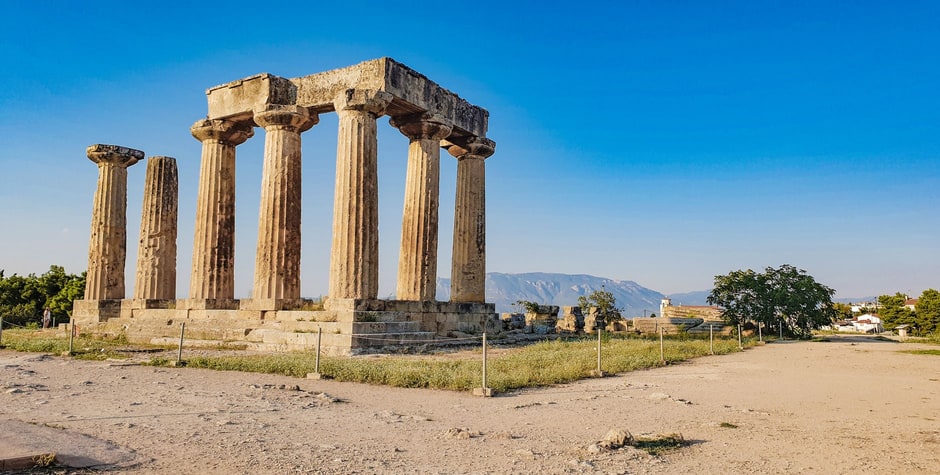

Corinth is three separate visits that people book as one, and the confusion costs them a day. The excavated city with its museum sits inland at the village of Ancient Corinth. The fortress of Acrocorinth stands on the mountain above it, a separate gate with a separate rule. The canal, the thing most travellers picture, is a further 10 km east and has nothing to do with either.
This guide sorts the things to do in Corinth by what they cost, when they are open, and how you get between them, because those three answers are what turn a vague day trip from Athens into a workable one.
One ticket covers the site and the museum
The Archaeological Museum of Ancient Corinth stands inside the excavated city, and the ministry sells them together. The ticket is 15 €, and the price includes entry to the archaeological site, so there is nothing to buy twice and no reason to choose between them.
| Season | Hours | Note |
|---|---|---|
| Summer, 1 April to 31 October | 08:00 to 19:00, and from 2 May 2026 08:00 to 20:00 | Last entry 20 minutes before closing |
| Winter, 1 November to 31 March | 08:30 to 15:30 | Short day; the museum and site both close |
| Every week, all year | Closed on Tuesdays | Site and museum both; check the day before you set out |
The address is simply Ancient Corinth 20007, and the site telephone is +30 27410 31207. The museum building itself dates from 1932 and was put up by the American School of Classical Studies, which still runs the excavation; that is why the display cases read like a dig report rather than a tourist gallery.
What you actually walk among is largely the Roman city that Julius Caesar refounded on the ruins of the Greek one. The exception, and the reason the skyline looks the way it does in every photograph of the place, is the Temple of Apollo. It went up around 550 BC with a colonnade of six columns by fifteen, and seven of them still stand. Each shaft is monolithic, cut from a single block of the local limestone rather than stacked from drums, which is a large part of why they are still there.
Acrocorinth is free, and the gate shuts at 15:30
The fortress above the city is a separate visit and entry is free: you pay only for the dig and its museum lower down. It is roughly 7 km from the modern town, uphill, on a road that ends at a car park below the lowest gate.
The closing time is the most useful fact on this page. The ministry lists Acrocorinth as open 08:30 to 15:30, every day, in both seasons: the same short window in January and in August. Down in the village the site keeps going until 19:00, and until 20:00 from 2 May 2026.
| Where | Opens | Closes | Weekly closure |
|---|---|---|---|
| Ancient Corinth, site and museum | 08:00 in summer, 08:30 in winter | 19:00 in summer, 20:00 from 2 May 2026; 15:30 in winter | Tuesdays |
| Acrocorinth, the fortress above | 08:30 | 15:30, all year | Open every day |
That gap is four and a half hours wide in summer, and it is where the wasted afternoon comes from: people do the ruins first, eat in the village, drive up at four and find the fortress shut. So the fortress goes first, or it does not go at all. Site telephone +30 27410 31266.
Two more numbers set expectations once you are up there. The circuit of walls runs to about 3 km, and a full walk around them takes up to two hours, which is another reason the 15:30 gate matters: arrive at two and you are choosing which half to skip. Nothing up there is shaded, and there is no water on the way round.
The canal, and the thing no older guide will tell you
The Corinth Canal spent most of the last year shut. It closed in mid-November 2025 after a run of rockfalls and small landslides on the Peloponnesian bank, and the operator reopened it to navigation on 17 June 2026, ahead of the July date that had been expected. In the company's own words, the canal "is now open to navigation" following the restoration works.
That matters for planning, and not only as history. Through the restoration the canal has been run in seasons: it was open from 8 March to 2 November 2025, then closed again for the next phase of works. If the point of your day is watching a ship squeeze between the walls, check the operator's announcements for the dates you are travelling rather than assuming a waterway is always a waterway.
The dimensions explain why the sight is worth the detour at all. These are the operator's own figures.
| Measure | Figure |
|---|---|
| Total length | 6 343 m, of which 540 m are the ports of Poseidonia and Isthmia at either mouth |
| Width safe for navigation, at sea level | 24.60 m |
| Width at the bottom | 21.00 m |
| Depth on the axis | 8.00 m |
| Maximum air draft | 52 m, limited by the rail and road bridges |
A cruise ship does not fit. What passes is small freight, yachts and tour boats, and they pass with metres to spare on either side, which is the whole spectacle.
The submersible bridges
At each end of the cut, at Poseidonia and Isthmia, the road crosses on a bridge that does not lift or swing. It sinks. The deck drops below the water so that a vessel can pass over it, then rises again and traffic drives on. Two of them are in service, and they are the reason the canal has road links at all without another high span.
If you are choosing a spot, the high bridges give you the long view down the cut and the submersible bridges give you the strange one: standing on a road that is about to be underwater.
The Diolkos: what the Greeks built instead
The idea of cutting the isthmus is old, discussed as far back as the seventh century BC. What got built instead was the Diolkos, a paved trackway across the neck of land on which ships were hauled bodily from one gulf to the other. Sections of the grooved stone are still in the ground near the western end of the canal, and they are free to look at.
It is a modest thing to see and a large thing to understand: for something like a thousand years, the answer to the isthmus was not to cut it but to carry boats across it.
Getting there from Athens
Corinth is one of the few Greek archaeological sites you can reach on a suburban train.
- Train. The Proastiakos suburban service on the Piraeus–Athens–Kiato line runs from Larissa Station in Athens roughly every hour and reaches Corinth in about 1 hour 5 minutes. It is the least fussy option and the easiest to reverse late in the day.
- Bus. KTEL coaches leave from the Kifissos terminal and take about 90 minutes to modern Corinth. Kifissos itself is the awkward part: metro to Elaionas, then bus 052 or a walk of roughly 1.5 km.
- Car. The motorway from Athens runs straight to the isthmus, which makes the canal a natural first stop before you turn inland to the site.
Neither the train nor the coach puts you at the ruins. Both arrive in the modern town, and from there it is a further 15 minutes to Ancient Corinth by local bus, roughly hourly, or about 10 € by taxi. Acrocorinth has no bus at all: that leg is a taxi or your own car.
The practical shape of the day, if you are coming without a car: canal first if you drive, otherwise train to Corinth, taxi up to Acrocorinth in the cool of the morning, walk down or ride down to the excavated city, and keep the last train in mind rather than the closing time.
Two day trips that follow the same ticket logic
Both of the obvious onward stops are single-ticket sites like Corinth, where one price covers the museum and the ground.
| Site | Ticket | What it covers | Hours |
|---|---|---|---|
| Nemea | 10 € | Museum, the excavated sanctuary and the Stadium | Summer 08:00 to 19:00, from 2 May 2026 to 20:00; winter 08:30 to 15:30; closed Tuesdays |
| Epidaurus | 20 € | Museum and the archaeological site of the Asklepieion | Summer 08:00 to 19:00, rising to 20:00 in high season; winter 08:00 to 17:00, later from March |
Nemea is the quieter of the two and the better value: the stadium with its vaulted entrance tunnel is included, and the museum sits inside the sanctuary of Zeus rather than in a separate town. Ancient Nemea, Corinth 20500, telephone +30 27460 22739.
Epidaurus costs twice as much and earns it on one thing, the theatre and its acoustics. Note that the ministry's card for Epidaurus does not state a weekly closing day, unlike the cards for Corinth and Nemea, so do not assume the Tuesday rule applies there. Sanctuary of Asclepius, Argolida 21052, telephone +30 27530 22009.
Where Corinth sits on the film map
Acrocorinth has a second claim on visitors this year: Christopher Nolan's The Odyssey filmed on the fortress, using it for the flashbacks of Agamemnon's arrival at Mycenae. Note what that means. Even here, at a real Greek citadel, the walls are standing in for a different citadel to the south rather than playing themselves, which is the pattern across the whole production. The full list is in our guide to the filming locations.
The two clearest cases of the substitution are worth naming. The island the poem is named after never appeared: Ithaca was played by an abandoned castle on Favignana in Sicily, and the real island turns out to have two of its headline Homeric sites closed to visitors, as the Ithaca guide sets out. Troy went to Morocco on screen, while the excavated Troy sits near Çanakkale on the Turkish coast and makes a real day out from Istanbul, and the Troy guide has the practical detail.
What to expect, plainly
Corinth is a half day of ruins with a good museum, a free fortress that asks two hours and gives back the best view in the region, and an engineering curiosity 10 km away that has only been working again since June. It is not a place that needs three days, and it rewards an early start more than a long one.
Three things actually derail visits here, and all three are fixable in advance: the fortress gate shuts at 15:30 while the site below stays open for hours longer, both site and museum are shut on Tuesdays, and the canal has spent much of the past year closed. Check both against your own dates, and the rest of the day looks after itself.