
Troy is not a ruined city you walk into. What survives at Hisarlık is a mound, roughly 4.8 km inland from the Dardanelles, with nine main settlements stacked inside it and a tenth, earlier layer found underneath. Some visitors leave delighted. Others leave asking where the city went. The difference is almost entirely a matter of what you knew before you arrived.
Visiting Troy in Turkey works best when you know what to expect, so this guide sets out what stands on the site today, what the museum next door holds, how to reach both from Istanbul, and whether the trip earns a day of your holiday. Ancient Troy joined the UNESCO World Heritage list in 1998, and the practical case for going has changed since then: a museum opened in 2018, and a bridge opened in 2022 that took roughly an hour and a half off the drive from Istanbul by removing the ferry queue.
What is actually on the site
Hisarlık is a tell, an artificial hill made of the rubble of one settlement built on the flattened remains of the last. Excavators cut into it rather than clearing it, so the visit is a walk along and across trenches, with signboards explaining which century each wall belongs to. You are looking at stone footings, gateways, a paved ramp and stretches of fortification, not standing temples.
Highlights that reward a slow look include the sloping east wall and tower of the Bronze Age citadel, the paved ramp Heinrich Schliemann exposed, the later Hellenistic and Roman sanctuary terraces, and the odeon at the southern edge. Wooden walkways guide you between them. Allow ninety minutes if you read the boards, an hour if you do not.
The nine layers, and which one might be Homer's
Archaeologists number the settlements Troy I to Troy IX, running from about 3000 BC to roughly 500 AD, with a still earlier phase, labelled Troy 0, going back to around 3600 BC. Four thousand years of settlement sit in one hill, repeatedly destroyed and rebuilt rather than carried on unbroken, which is what makes the site scientifically important quite apart from the poem.
Which layer, if any, hosted the Trojan War is a genuinely open question. Signs of violent destruction at roughly the right period appear in Troy VI and Troy VIIa, which makes them the usual candidates, yet there is no direct evidence of a Greek attack on the city. Schliemann himself picked wrong: he identified the far older Troy II as Homer's city because its finds were spectacular, and cut through later layers to reach it. Anyone telling you which room Priam slept in is inventing.
Two horses, and the one most people photograph is the wrong one
Confusion here is almost universal, so it is worth getting straight before you go. There are two Trojan horses in the area, about forty minutes apart, and they have nothing to do with each other.
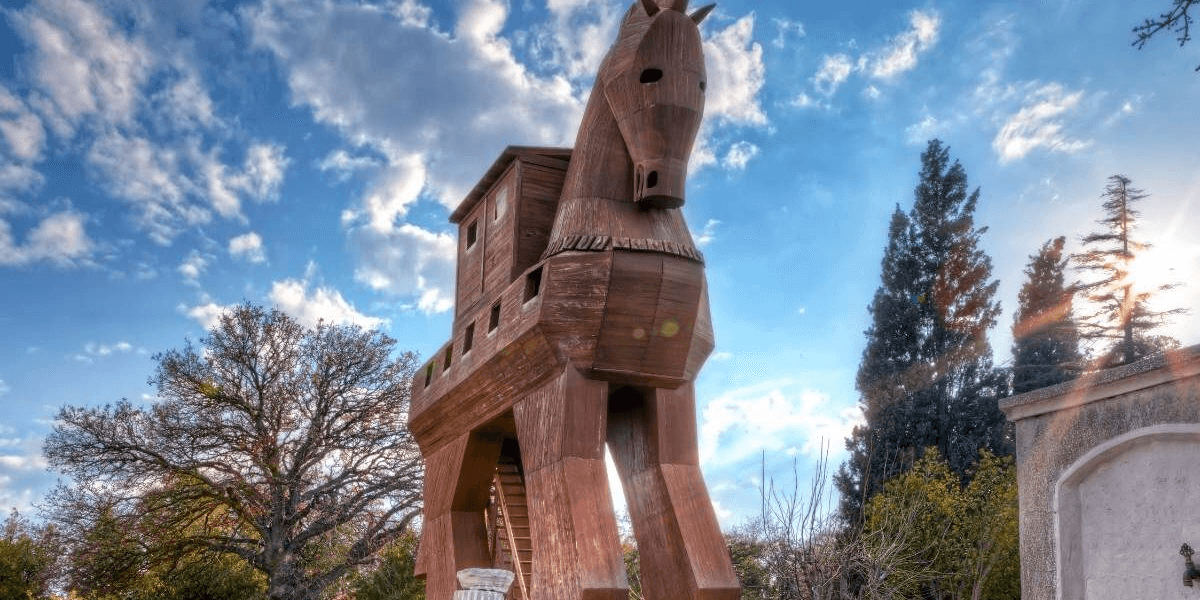
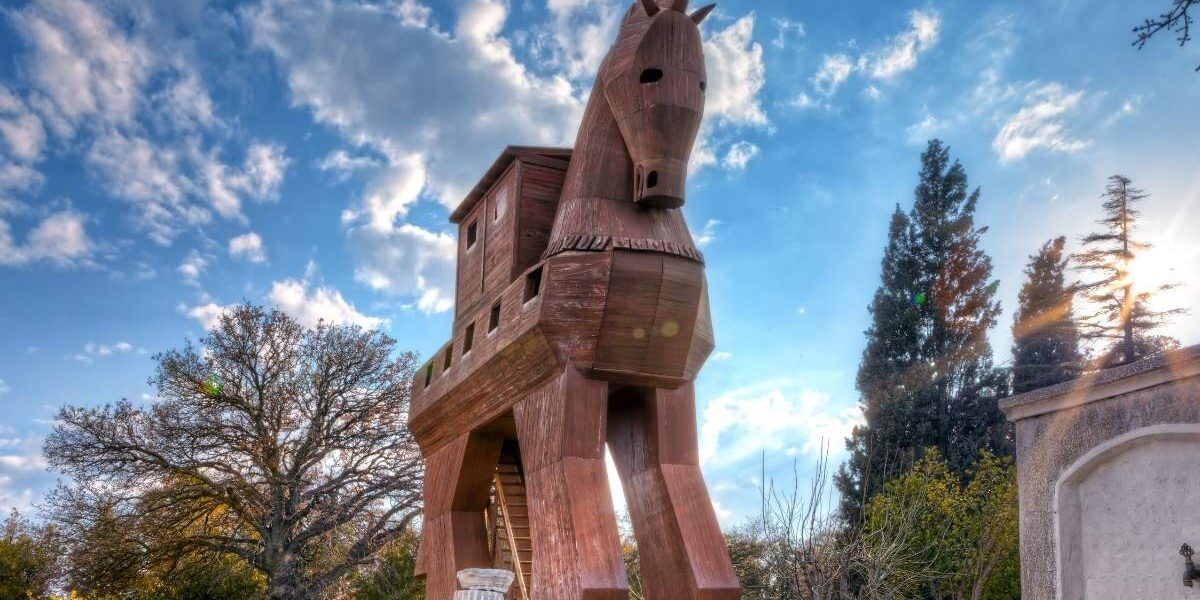
At the entrance to the archaeological site stands a wooden horse built in the mid-1970s by the Turkish architect İzzet Senemoğlu. Accounts of its height differ, with roughly 12.5 m in the technical descriptions and 15 m quoted elsewhere; it took around 25 cubic metres of pine from Kaz Dağı, and you can still climb the ladder inside it and look out of the windows. Children love it. It makes no claim to be ancient.
On the seafront promenade in Çanakkale town stands a different horse entirely: the screen-used prop from Wolfgang Petersen's 2004 film Troy, given to Turkey by Warner Bros. and displayed there since 13 September 2004. Despite appearances it is not wooden at all, but a steel frame skinned in fibreglass. Most photographs captioned "the Trojan horse at Troy" online are actually of this one, in a town square, thirty kilometres from the ruins.
The museum is the reason to come now
Before 2018 the complaint about Troy was fair: the finds were elsewhere, in Istanbul, Berlin, Moscow and the local Çanakkale museum, and the site itself gave visitors stones and imagination. The Troy Museum, opened on 10 October 2018 in the village of Tevfikiye a short walk from the entrance, changed that.
Its building came from a design competition won in 2011 by the Turkish practice Yalın Mimarlık, and it reads as a rust-coloured cube whose lower floors sit below ground level, so that you climb up through the exhibition much as an excavator digs down. Seven sections cover the Troas region, the layers of the city, the Trojan War in later art, and the archaeology of the digs themselves, including objects from other ancient sites nearby and on the neighbouring islands. In 2020 it received a Special Appreciation Award from the European Museum of the Year scheme and a European Museum Academy award.
Set aside ninety minutes. Visitors who do the mound first and the museum second generally understand what they saw far better than those who do it the other way round, so consider walking the trenches first even though the museum is the more comfortable building.
Getting there from Istanbul
Everything hinges on the crossing of the Dardanelles. Until 2022 the road route meant a ferry queue; the 1915 Çanakkale Bridge opened on 18 March 2022 with a main span of 2,023 m, taking the world record from Japan's Akashi Kaikyō Bridge and its 1,991 m, and the drive shortened considerably.
| How | Istanbul to Çanakkale | Then to the site | Suits |
|---|---|---|---|
| Intercity bus | 5–6 hours | Dolmuş from Çanakkale, about 45 minutes to Tevfikiye, then a walk of some 500 m to the gate | Budget travellers with an overnight in Çanakkale |
| Own or hired car, over the bridge | Around 3.5–4 hours for the 308 km | Signposted; the car park at the ruins is paid, the museum car park about 800 m away is not | Anyone combining Troy with the Aegean coast |
| Organised day trip | Included, usually a dawn start | Included | One-day visitors who do not want to drive |
| Flying | No non-stop service | Hire car or taxi | Rarely worth it, see below |
Staying a night in Çanakkale turns a punishing day into a relaxed one, and the town is pleasant: a working port with a long promenade, fish restaurants and the film horse at the end of it. Should you prefer to sleep in Istanbul, our round-up of day trips from Istanbul puts the distances side by side, and Troy is at the far end of what a single day comfortably holds.
The flight that looks convenient and is not
Çanakkale has an airport, code CKZ, which raises hopes of a one-hour hop. Check the timetable before you build a plan on it. Scheduled service in 2026 is a domestic link to Ankara, not to Istanbul, so booking sites that quote you an Istanbul to Çanakkale fare are routing you through a connection. Door to door that lands you slower than the bus and considerably poorer.
Air service to small Turkish airports does change, sometimes seasonally, so it costs nothing to look. Just do not assume the flight exists because a search engine sold you a price for it.
Adding Gallipoli, or leaving it alone
Tour operators pair Troy with the Gallipoli battlefields, and geographically that makes sense: the peninsula lies across the strait, and the bridge has made the loop easier. Emotionally the pairing is harder than the brochures admit. Gallipoli is a country of war cemeteries where families come to find a name, and forty minutes after climbing a replica horse the shift in register is abrupt.
Our advice, if the day allows only one, is to choose by why you came. Readers drawn by the Iliad should give the mound and its museum an unhurried morning. Readers with a connection to 1915 deserve more than a stop between other sights, and our guide to the Gallipoli memorials and the practical Gallipoli day trip from Istanbul cover that side properly.
Hours, tickets and how long to allow
Opening times follow two regimes, and the Ministry of Culture and Tourism publishes both on its own listing for the site. Summer runs from 1 May to 1 October, daily, 08:30 until 20:00, with the ticket office closing at 19:30. Winter covers the rest of the year, 08:30 until 17:30, ticket office at 17:00. Neither the ruins nor the museum takes a weekly closing day.
Watch the changeover rather than the season you think you are in. Arrive in mid-April or mid-October expecting a summer evening and you meet a ticket office that shut at 17:00. Holiday closures and the exact switching dates do move, so check the ministry listing in the week you travel, not a blog, ours included.
Museum Pass Türkiye covers the ruins as well as the museum, and pays for itself quickly if you are visiting several state museums on the same trip. Entrance prices are set annually and change, so we do not quote figures here; check the official listing when you book rather than trusting a blog, ours included.
Practical notes worth more than they sound:
- Shade is scarce on the mound. Between June and August, go early or late rather than at midday.
- The walkways are uneven in places and there are steps. Sandals are a poor choice.
- Signage is bilingual and good, but a guide earns their fee here more than at most sites, because the interest lies in telling nine layers apart.
- The museum has the cafe and the air conditioning. Plan your break there, not at the ruins.
- Without a car, check the minibus timetable rather than the closing time. Services run through the day, but not on a neat hourly pattern, and gaps of a couple of hours are normal. The timetable is reset seasonally and revised locally, so published times go stale quickly; in summer the last return runs in the evening rather than the late afternoon, but confirm it on the day at the station.
Who should skip it
Honesty serves you better than enthusiasm. Travellers who want photogenic classical architecture will be happier at Ephesus and Pamukkale, where marble streets still stand and a single glance explains itself. Those with two or three days in Turkey and a first visit to Istanbul should spend them on the city; our short Istanbul itinerary and the fuller Istanbul travel guide lay that out. Trips built around scenery are better served by Cappadocia or the terraces of Pamukkale.
The site rewards a specific kind of curiosity: an interest in how we know what we know, in the argument between a poem and a trench, in a hill that held a city for four millennia. Come for that and the stones are gripping. Come expecting the film set and you will have driven six hundred kilometres to see a field.
The site also appears in a wider story we have mapped separately. Christopher Nolan filmed his Odyssey at Aït Benhaddou in Morocco rather than here, and our guide to where The Odyssey was filmed explains why the real Troy stayed off the schedule while a Moroccan ksar played it on screen.