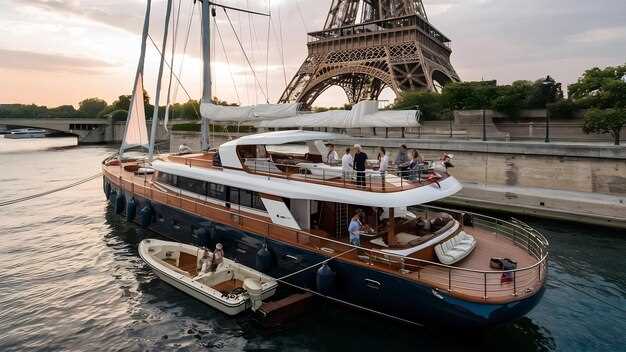

Two companies run most sightseeing boats on the Seine, and they are not interchangeable. Bateaux-Mouches started in 1949 and departs from Pont de l'Alma. Bateaux Parisiens started in 1956 and departs from beside the Eiffel Tower. One leans towards a straightforward hour on the water, another towards dining on board. Choosing badly means an hour you did not want, so here is what actually separates them.
The short comparison
| Feature | Bateaux-Mouches | Bateaux Parisiens |
|---|---|---|
| Founded | 1949, by Jean Bruel | 1956 |
| Owner today | Compagnie des Bateaux-Mouches, independent | Sodexo, since 1987 |
| Main departure | Pont de l'Alma, right bank | Port de la Bourdonnais, by the Eiffel Tower |
| Fleet | Large glass-covered boats | 12 boats: 8 for sightseeing, 4 for dining |
| Best for | A classic sightseeing hour | Lunch or dinner afloat |
Bateaux-Mouches: 1949, and a fictional founder
Jean Bruel founded Compagnie des Bateaux-Mouches in 1949. He bought one of the last steamboats used at the 1900 Universal Exhibition and did something new with it: guided tours without stops, leaving from a fixed port and returning to that same port. Before Bruel, river boats mostly moved people between places.
Then came one of the better marketing stunts in Paris history. On 1 April 1953 Bruel inaugurated a new boat, the Jean-Sébastien Mouche. At the ceremony a transport minister unveiled a bust of a man with that name and introduced him as the inventor of the Bateaux-Mouches. No such person existed. Bruel had invented him, and the name stuck so well that visitors still repeat it.
Scale followed. Bateaux-Mouches now counts as the fourth most visited attraction in Paris, behind only the Eiffel Tower, the Louvre and the Pompidou Centre. Roughly 2.6 million people board one each year.
Bateaux Parisiens: 1956, and a turn towards dining
Bateaux Parisiens began in 1956 with a different aim: an exclusive way for visitors to see Paris from the water. Seven years separate it from Bateaux-Mouches, and the gap shows in what each company built its business on.
In 1987 the Sodexo group bought the company, which today runs it through its Seino Vision arm, and that purchase changed what it sells. Sodexo runs catering and leisure services worldwide, so investment went into dining: restaurant boats, panoramic windows, structured service on board. Today Bateaux Parisiens operates 12 boats: eight for sightseeing and four built as floating restaurants. The sightseeing boats carry the names of French figures, among them Jean Marais, Brigitte Bardot, Jeanne Moreau and Catherine Deneuve; the restaurant boats are Diamant II, Cristal II, Onyx and Bretagne.
That history explains a difference you notice at the dock. Bateaux-Mouches grew out of sightseeing and added catering. Bateaux Parisiens grew into catering after 1987 and kept sightseeing alongside it.
Where each one leaves from
This decides more than most travellers expect, because a boarding point sets up the whole trip.
- Bateaux-Mouches, Pont de l'Alma. Right bank, close to Avenue Montaigne and a walk from the Champs-Élysées. Metro Alma-Marceau on line 9. Good if you are already in that part of the 8th arrondissement.
- Bateaux Parisiens, Port de la Bourdonnais. Directly below the Eiffel Tower. Convenient when the tower is on your day's list anyway, and the queue there is often the busier of the two.
Both routes cover the same central stretch of river, so the sights barely differ: Notre-Dame, the Louvre, Musée d'Orsay, Pont Alexandre III, Île de la Cité. What differs is which end you start from and how the light falls on your side of the boat.
Which to pick, by what you want
An hour of sightseeing, nothing more. Either works. Bateaux-Mouches has the larger glass-covered boats and the longer pedigree, and its departure point stays calmer than the Eiffel Tower dock in summer.
Dinner on the Seine. Bateaux Parisiens, with four boats built for it and a parent company whose business is catering. Book a window table rather than trusting the seating plan.
Travelling with children. Bateaux-Mouches, for a shorter, cheaper trip without a meal to sit through. An hour is the limit of most children's patience on water.
A special occasion. Bateaux Parisiens again, though check what the price covers. A dining cruise at a fixed hour leaves no room to linger over dessert.
Photographs. Either, but time it rather than picking a brand. Late afternoon light on stone is the reason to go; midday sun through glass roofs is not.
What you actually see from the water
Both companies run the same central loop, so the sights are effectively identical. Going downstream and back, a standard hour passes:
- Pont Alexandre III. Gilded lamps and nymphs, built for the 1900 Universal Exhibition, and the most photographed bridge on the route.
- Musee d'Orsay. A railway station until 1939, now the Impressionist collection, seen from the river as a long glass roof.
- Louvre. The Denon and Flore wings run along the right bank for several hundred metres.
- Ile de la Cite and Notre-Dame. The eastern turning point for most cruises, with the cathedral's flying buttresses facing the water.
- Pont Neuf. Completed in 1607 and, despite its name, the oldest standing bridge in Paris.
- Saint-Germain-des-Pres. The left bank behind the quays, glimpsed rather than toured.
Sit on the right side going downstream for the Louvre, and on the left for the Eiffel Tower on the return. That single choice affects your photographs more than which company you booked.
Cost and time, in plain terms
A sightseeing cruise with either operator runs about an hour and costs a fraction of a dining cruise. Prices move by season and by booking channel, so check the operator's own site on the day rather than trusting a figure in any guide, this one included. A lunch or dinner cruise with Bateaux Parisiens costs several times the sightseeing fare, which is what buys the restaurant boat and the service.
One booking note applies to both. Buying at the dock works outside high season; in July and August the Eiffel Tower departure point queues badly, and booking ahead saves more time at Port de la Bourdonnais than at Pont de l'Alma.
Practical points for both
- Board early. Seats on the open upper deck and by the windows go first, and boarding starts before the scheduled departure.
- Check the commentary. Recorded multilingual commentary is standard on sightseeing cruises. Live commentary in one language is a different experience, so confirm which you are getting.
- Dress for water. An open deck on the Seine is colder than the street, and that holds even in July.
- Watch the bridges. Pont Alexandre III and Pont Neuf are the two worth having a camera ready for.
- Confirm the duration. Sightseeing loops run around an hour; dining cruises run considerably longer, and a two-hour dinner cruise is a whole evening.
A note on the group sizes
Boats on this river take large numbers. Capacity on the bigger vessels runs into the hundreds, and small private gatherings of 15 or so people sit at the other end of the range. If crowd size matters to you, ask how many passengers the specific boat carries rather than assuming a company standard. A restaurant boat with five sittings has a different feel from a sightseeing boat with 400 seats.
Both companies have been running longer than most Paris hotels: Bateaux-Mouches since 1949 and Bateaux Parisiens since 1956. Neither will disappoint on the river itself. Choose by the boarding point that fits your day, and by whether you want a meal or an hour.