


 Українська
  English (UK)
  Русский
  বাংলা
বাংলা  العربية
  日本語
日本語  한국어
한국어  Magyar
  Norsk nynorsk
  Türkçe
  עִבְרִית
  Español
  Čeština
  Svenska
  Português
  Ελληνικά
  Suomi
Suomi  Nederlands
  Română
  Italiano
  Français
  Polski
  Deutsch
  简体中文
简体中文  Slovenčina
  Српски језик
  اردو
اردو  Azərbaycan dili
  O‘zbekcha
  አማርኛ
አማርኛ 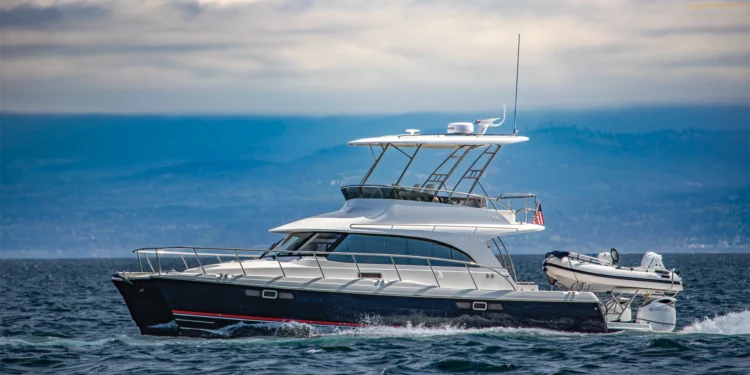 Aspen C128: How a 46-Foot Power Catamaran Handles Long-Range Cruising and Charter Use">

Marina logistics and fuel planning for a 46' Aspen C128
With an LOA of 46′, a beam of 13’ 11”, and a 300-gallon expedition tank, the Aspen C128 is designed to fit most standard berths while supporting extended passages that demand careful fuel and berth planning. Operators should account for the boat’s draught when reserving marina space, ensure access to appropriate shore power for enhanced air conditioning capacity in tropical regions, and plan fuel bunkering that matches the boat’s dual-outboard configuration and long-range mission profile.
Hull architecture and its implications for efficiency
The Aspen proprietary PROA hull uses dissimilar hull volumes to reduce resistance: one hull carries roughly one-third less displacement in longitudinal sections whilst maintaining required buoyancy. This results in a narrow entry that slices waves and a tunnel form that reduces slapping in head seas by allowing the forward tunnel to cut through wave tops and funnel water aft. These hydrodynamic choices translate into steadier fuel consumption and predictable planning margins for charter operators and expeditioners alike.
Design adaptations for outboards
To accommodate the weight and thrust line of twin outboards, founder and chief engineer Larry Graf modified the C120 hull form by removing rudder and keel elements and extending aft sections for additional flotation and better tracking. The C128 retains Aspen’s non-planing behaviour, which smooths acceleration and improves fuel-efficiency envelopes across cruising speeds.
Propulsion, redundancy and onboard systems
The test configuration uses twin Suzuki 300HP DF300BMB outboards with contra-rotating props. Identical engines simplify parts inventory and provide operational redundancy—crew can run on a single engine for extended legs if required. For charter yachts and expedition use, this means fewer logistical headaches when sourcing spares in remote ports and predictable performance characteristics during single-engine motoring.
Practical benefits for tourism operators
Greater AC capacity, extended range at trawler speeds, and ample accommodation for provisioning make the C128 viable for long-season charters in Florida, the Bahamas and the Caribbean. The cat’s stability and low bow rise (measured under 2 degrees during trials) improve guest comfort during island-hopping itineraries and coastal museum tours with live guides.
Handling, docking and helm ergonomics
Despite its beam, the C128 manoeuvres tightly thanks to separated engines and counter-rotating props that allow fine throttle differential steering similar to a twin inboard. A bow thruster mounted in the wider starboard hull augments close-quarters control. The helm layout features two bucket seats, dual windscreens and a large MFD pod, with convenient companion seating for a small tour guide or hostess.
| Specification | Value |
|---|---|
| LOA | 46′ |
| Beam | 13’ 11” |
| Fuel Capacity | 300 gallons |
| Engines | 2 x Suzuki DF300BMB |
| Peak Speed (test) | 30.5 mph |
Performance highlights and range planning
Acceleration is smooth—0–20 mph in about 9. 5 seconds—and peak speed reached 30.5 mph at moderate RPMs with noise levels of 59–82 dB. At a 20 mph cruise the burn was approximately 97.2 litres per hour, delivering a planning range near 252 miles (based on 90% usable fuel). Slowing to trawler speeds markedly improves range (462 miles), and single-engine economical motoring extended that figure even further to about 579 miles at 7.9 mph.
Operational checklist for charter and adventure operators
- Confirm berth dimensions and stern-to or side-tie preferences in advance.
- Verify shore-power capacity to support elevated AC loads for tropical charters.
- Maintain stock of common Suzuki parts for remote serviceability.
- Plan legs with varying speeds to optimise range while meeting schedule constraints.
Why the C128 matters to travel and charter markets
The Aspen C128 blends stability, efficient hull form and outboard redundancy to create a platform suitable for boutique yacht charters, eco-friendly wildlife safaris, and shore-excursion staging. Its ability to operate efficiently at both higher cruise speeds and low-trawler paces makes it flexible for everything from luxury adventure travel experiences to intimate museum tours with live guides or exclusive yacht charters for events.
Technical reviews and measured performance metrics offer valuable guidance, but even the best reviews and the most honest feedback can't truly compare to personal experience. On GetExperience, you book your experience from verified providers at reasonable prices; payments are made securely through the site with voucher confirmation issued afterwards, and you can submit tailored requests so providers respond with offers that match your needs. This transparency and convenience help travellers avoid unnecessary expenses or disappointments while accessing a wide range of additional options and curated excursions. Book now GetExperience.com
In short, the Aspen C128 is a compelling choice for operators and owners seeking a 46-foot power cat that balances comfort, fuel economy and redundancy. Its PROA-derived hull and twin Suzuki 300s produce predictable handling and useful speed bands for long-distance cruising or specialised charters. Whether you’re considering adventure rafting trips for beginners, exclusive yacht charters for events, cruise packages, safari tours or interactive online cultural workshops to supplement on-board programming, the C128 can be configured to support a wide range of travel experiences and adventure activities while keeping operational logistics manageable.