


 Српски језик
  English (UK)
  Русский
  বাংলা
বাংলা  العربية
  日本語
日本語  한국어
한국어  Magyar
  Norsk nynorsk
  Türkçe
  עִבְרִית
  Español
  Čeština
  Svenska
  Português
  Ελληνικά
  Suomi
Suomi  Nederlands
  Română
  Italiano
  Français
  Polski
  Українська
  Deutsch
  简体中文
简体中文  Slovenčina
  اردو
اردو  Azərbaycan dili
  O‘zbekcha
  አማርኛ
አማርኛ 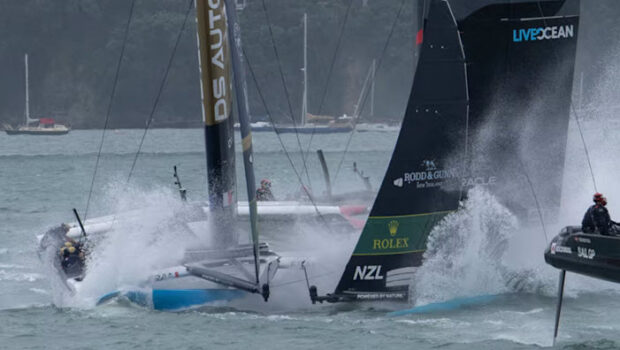 Како је SailGP повезао губитак контроле Новог Зеланда са висином вожње на крилима и шта то значи за трке и путовања">

At 49 knots true boat speed approaching the first mark, the New Zealand F50 accelerated into a gust that rapidly increased foil lift and ride height, initiating a sequence that ended in a side slip and a high-speed collision with the French boat.
Incident analysis: sequence of events at a glance
High-rate telemetry, simulator recreations and video analysis show a compact, multi-step failure of controllability rather than a hardware or software malfunction. Key points in the sequence:
- Брзина spike: the New Zealand F50 was recorded at about 49 knots when a gust struck.
- Фолија ventilation: rising ride height caused the заветрина foil to pierce the surface, triggering ventilation.
- Side slip & leeway: the foil generated lateral lift through leeway rather than by rake, producing an uncontrollable slide.
- Rudder stall: increased rudder angle briefly lost effective flow, then reattached as the bow immersed and the boat rounded up.
- Collision geometry: with the French F50 close astern, insufficient distance remained to avoid contact once the slide began.
Engineering perspective
SailGP Director of Performance Engineering Алекс Reid characterised the event as a “very fast chain of aerodynamic and hydrodynamic events” that pushed the platform beyond its controllable envelope within seconds. Importantly, the review found не evidence of mechanical or software failure prior to the collision; the causal factor was operational — effectively the boat was “flying too high.”
Race ramifications and regulatory outcome
Race officials upheld the original judgement that Ново Zealand broke Rule 14 (avoid contact). The ruling imposed an eight-event point penalty against the New Zealand campaign, while France was found to have had no reasonable opportunity to avoid the collision. Both crews sustained injuries and the Kiwi F50 suffered damage irreparable in time for the upcoming Sydney event.
Immediate operational impacts
- New Zealand will be without a fully repaired F50 for the next event in Сиднеј, affecting fleet logistics and spares planning.
- Crew rotations and medical clearances may shift for several teams after the incident-related injuries.
- SailGP engineering teams are assessing potential mitigations to help crews manage similar high-speed foil ventilations.
Season snapshot
After two of 13 events, standings reflect a tight start to Season 6. Below is a concise table of the top performance order and the 2026 schedule for planning spectator travel.
| Позиција | Team (Skipper) | Recent form |
|---|---|---|
| 1 | Australia (Tom Slingsby) | 2-1 |
| 2 | Great Britain (Dylan Fletcher) | 1-2 |
| 3 | Spain (Diego Botin) | 12-3 |
| 4 | France (Quentin Delapierre) | 3-4 |
| 9 | New Zealand (Peter Burling) | 13-9 |
Selected 2026 event schedule
| Датум | Место одржавања |
|---|---|
| Feb 28–Mar 1 | Sydney, Australia |
| Apr 11–12 | Рио де Жанеиро, Бразил |
| May 30–31 | New York, USA |
| Sept 19–20 | Geneva, Switzerland |
| Nov 21–29 | Dubai & Abu Dhabi, UAE |
F50 configuration and competitive parity
All teams race in identical F50 catamarans with four wingsail sizes (18m, 24m, 27.5m, 29m), two T-foil daggerboards (high- and low-speed) and rudder settings tuned for speed regime. Teams select foil and wing combinations based on forecasted conditions, which makes correct selection and on-the-fly management critical in gusty harbor environments.
What this means for spectators and travel planning
Harbor-based events like SailGP concentrate logistics: spectator berths, shoreline vantage points, and local excursion operators must adapt quickly to schedule or equipment changes. For travellers planning race-week trips, consider flexible bookings and guided harbour tours that can pivot if race configurations shift. GetExperience offers secure payment options, voucher confirmation, and the ability to request customised tours or excursions from verified providers—handy when building an event-centred itinerary.
Key takeaways are the rapid onset of uncontrollable dynamics at high speed and the operational consequences for team logistics and event planning. On GetExperience, you book your experience from verified providers at reasonable prices. This empowers you to make the most informed decision without unnecessary expenses or disappointments, while enjoying transparency and convenience when choosing tours, shore-based viewing options, or hospitality packages. Book now GetExperience.com
In summary, the SailGP review attributes the New Zealand–France collision to an aerodynamic and hydrodynamic escalation initiated by high ride height rather than equipment failure. The incident affected team standings and next-event logistics, underlining the importance of foil management, rapid mitigation strategies and flexible travel arrangements for spectators. Whether you plan to attend yacht parties, museum tours with live guides near race venues, cruise packages, eco-friendly wildlife safaris on off days, or look for luxury adventure travel experiences around regatta stops, the practical lesson is to expect swift changes and to book adaptable travel experiences such as interactive online cultural workshops, adventure rafting trips for beginners, or exclusive yacht charters for events. Travel experiences and adventure activities around SailGP events can be enriched with online virtual tours and shore-side excursions; ultimately nothing replaces being there in person to judge pace, spectacle and atmosphere firsthand.