


 Norsk nynorsk
  English (UK)
  Русский
  বাংলা
বাংলা  العربية
  日本語
日本語  한국어
한국어  Magyar
  Türkçe
  עִבְרִית
  Español
  Čeština
  Svenska
  Português
  Ελληνικά
  Suomi
Suomi  Nederlands
  Română
  Italiano
  Français
  Polski
  Українська
  Deutsch
  简体中文
简体中文  Slovenčina
  Српски језик
  اردو
اردو  Azərbaycan dili
  O‘zbekcha
  አማርኛ
አማርኛ 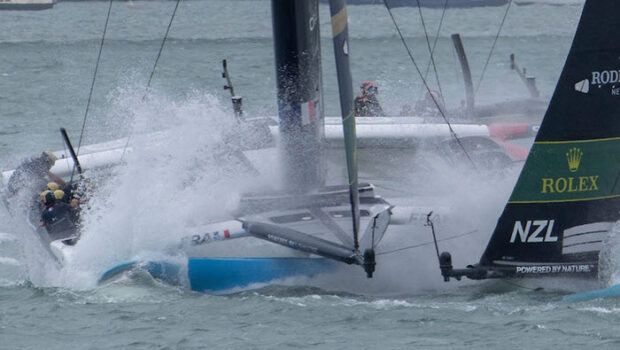 Ọ̀Nà tí Ìgbìmọ̀ Àṣẹ́jú SailGP gbà ń ṣe ìmújáde ìdájọ́ láti ibi jíjìn àti “Ààyè Ìdánilójú Tó Kẹ́yìn” Ṣe Ń nípa lórí Ààbò Ìdíje àti Àwọn Ìṣẹ̀lẹ̀ Ìgbafẹ́">

At the second event of the 2026 SailGP season two F50 foiling catamarans collided at high speed, sending two sailors to hospital — one with compound fractures in both legs — and raising urgent questions about how rule interpretation, technology, and race incentives interact on race courses that also underpin a growing tourism and spectator market.
The “last point of certainty” as a safety buffer
The principle known across umpired sailing formats holds that, in doubt, the situation should be judged according to the most recent point of clear knowledge — the last point of certainty. In practice, that means overlaps and entitlements to mark-room continue to exist until it is indisputably certain they have ceased. That margin creates space in distance and space in time for human reaction, an intentional safety feature embedded in the Racing Rules of Sailing.
From human judgement to data-verified certainty
SailGP’s model of remote umpiring uses multiple camera angles, telemetry, and computer-verified positioning to make post‑event determinations with extreme precision. Where on-water umpires and competitors once relied on what could be known and reacted to in real time, decisions in this system are grounded in later-confirmed technical accuracy. That shift changes what sailors perceive as acceptable risk and rewards behaviors that minimize lost time or distance right up to the razor’s edge.
How incentives transform behavior
When rule enforcement rewards being “technically clear” by later measurement rather than being obviously clear to another helmsman in the moment, crews optimize for the measured threshold. Overlaps are often broken at the last measurable instant, leaving virtually no practical bailout for a boat that had been inside seconds earlier. Windward boats press down on leeward boats until bows are separated by mere centimeters, all at maximum load and foiling speed. The elimination of conservatively applied uncertainty erodes the safety margins sailors have relied upon for decades.
| Traditional Umpiring | Remote, Data-Based Umpiring |
|---|---|
| Decisions based on human perception in real time | Decisions based on telemetry and post-event verification |
| Built-in uncertainty favors conservative action | Precision favors optimization to technical thresholds |
| Greater practical margin for human reaction | Smaller practical margin — higher risk at top speed |
Why precision does not automatically equal safety
Precision removes the buffer that uncertainty provides. Humans cannot reliably react in centimeters or milliseconds, especially under pressure, with noise, spray, and the physiological stresses of competition. A system that trains sailors to exploit late, exact clearances will predictably produce incidents when things go wrong — and on foiling multihulls the consequences escalate rapidly.
Practical measures to balance spectacle and safety
- Reinstate or emphasize the functional application of the last point of certainty in high-speed formats.
- Require a human-in-the-loop standard for real-time overlap assessment at critical marks.
- Introduce mandatory safety margins or reduced approach speeds at congested marks for foiling classes.
- Improve visible signaling and on-deck communication protocols to compensate for late digital decisions.
- Expand race‑specific training emphasizing conservative decisions under pressure.
Implications for tourism and spectator experiences
Elite regattas like SailGP have become major draws for coastal tourism, influencing cruise packages, yakɔtu parties, shore-side hospitality, and local transport planning. When racing incentives shift toward thinner safety margins, organizers and destination managers must consider impacts on spectator safety, insurance, and the continuity of travel experiences. Spectator zones, tender services, and coastal event logistics all depend on predictable, safe racing outcomes to keep tourist confidence high.
Race organizers can still deliver spectacle without sacrificing safety: clearer enforcement that preserves human reaction time will protect athletes while maintaining the close, dramatic boat-on-boat action that attracts crowds, cruise guests, and charter clients.
At a glance, the debate over umpiring precision is more than a technicality — it shapes how events are run, how hotels and transport are scheduled, and how njọ́nà experiences around regattas are packaged and sold. For travelers seeking curated sailing experiences, platforms like GetExperience provide secure online payment, voucher confirmations, and the ability to submit tailored requests to providers so you can find the best spectator tours or shore excursions for your needs. On GetExperience, you book your experience from verified providers at reasonable prices, which helps you make well-informed choices without unnecessary expense or disappointment. Book now GetExperience.com
In short, the conflict between technological precision and human-centered safety boils down to incentives: systems that remove uncertainty encourage optimization at the cost of safety margins. Restoring a role for the last point of certainty, combining human judgement with technological aids, and updating event logistics and training can preserve both competitive drama and the travel and tourism value these events create.
Summary: Remote, data-driven umpiring in SailGP-style events alters racing incentives by replacing practical human certainty with post-event technical certainty, which reduces safety margins and increases crash risk; solutions include reaffirming the last point of certainty, introducing real-time human oversight, and adjusting event logistics to protect athletes and spectators. The outcome affects travel experiences tied to regattas, from yacht parties and cruise packages to museum tours with live guides and eco-friendly wildlife safaris offered in host regions, and even opportunities for interactive online cultural workshops or luxury adventure travel experiences linked to major events.