


 Norsk nynorsk
  English (UK)
  Русский
  বাংলা
বাংলা  العربية
  日本語
日本語  한국어
한국어  Magyar
  Türkçe
  עִבְרִית
  Español
  Čeština
  Svenska
  Português
  Ελληνικά
  Suomi
Suomi  Nederlands
  Română
  Italiano
  Français
  Polski
  Українська
  Deutsch
  简体中文
简体中文  Slovenčina
  Српски језик
  اردو
اردو  Azərbaycan dili
  O‘zbekcha
  አማርኛ
አማርኛ 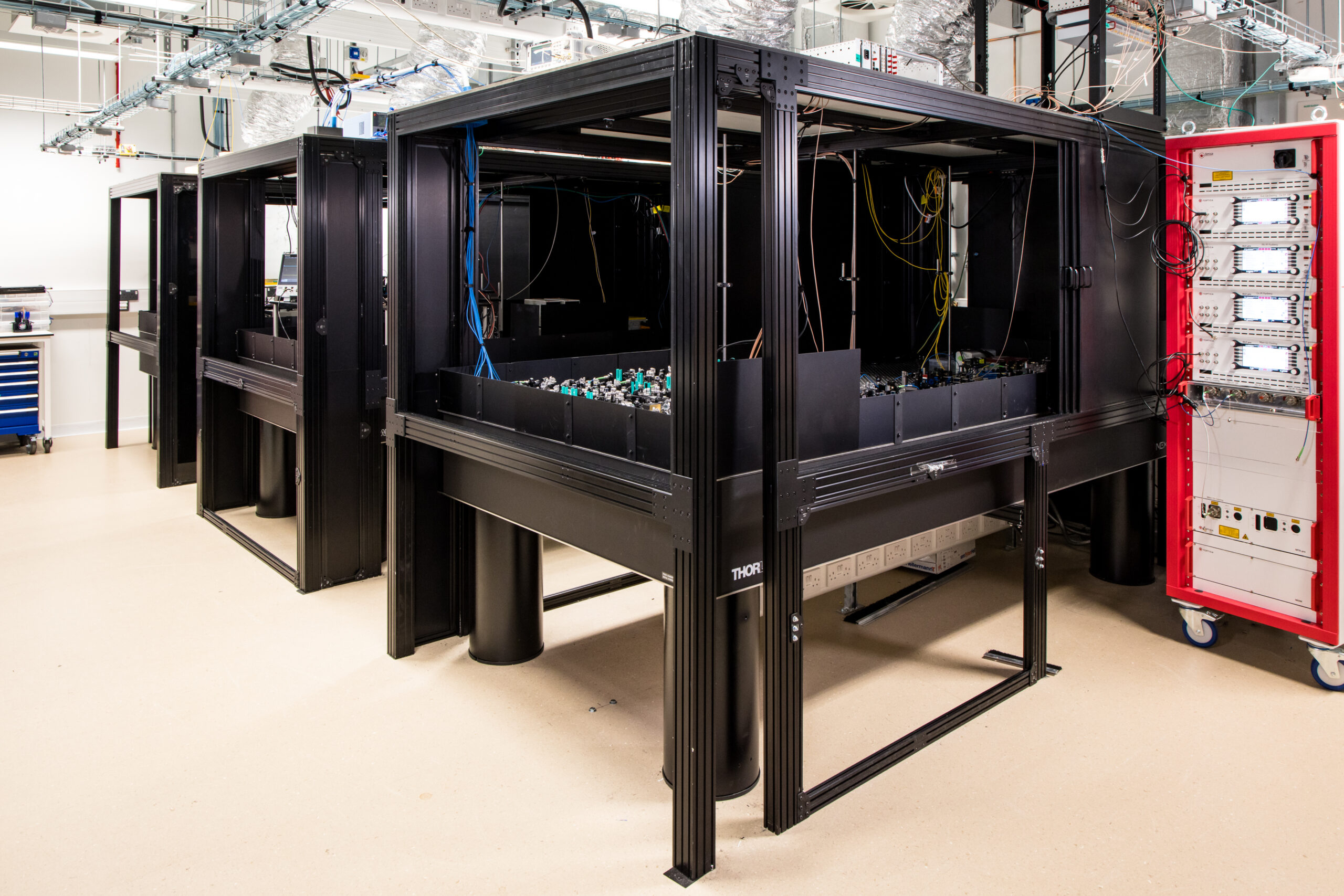 อนาคตของการประมวลผลควอนตัม: ปลดล็อกด้วยการควบคุมอะตอมและเทคโนโลยีเลเซอร์">

A Glimpse Inside the Quantum Realm of Computing
Step into the extraordinary world where lasers and atoms come together to revolutionize computation. At the National Quantum Computing Centre (NQCC) in Harwell, Oxfordshire, cutting-edge prototypes harness individual atoms to unlock computational possibilities far beyond classical computers’ reach.
The Groundbreaking Facility and Its Quantum Pursuits
The recently inaugurated NQCC, spanning 4,000 square meters and backed by almost £100 million in investment, serves as Britain’s flagship hub for quantum research. This facility congregates various quantum computing technologies, each vying to prove its worth in this nascent field.
Within this space, intriguing machines operate behind sleek black shutters designed to block both potent laser beams and environmental disturbances such as vibrations or heat. These safeguards are critical to preserving the fragility of the quantum states these machines manipulate. Among these are cold superconducting circuits, ion traps, photonic processors, silicon-chip-based units, and an especially promising neutral-atom quantum computer that is at the forefront of current research.
Neutral-Atom Quantum Computers: A Symphony of Light and Matter
Neutral-atom systems control atoms like chess pieces, positioning them precisely using finely tuned lasers known as optical tweezers. These atoms act as quantum bits—or qubits—capable of existing in a superposition of states: on, off, or intriguingly both simultaneously. This is fundamentally different from traditional bits, which are firmly on or off.
The magic lies in quantum entanglement, a peculiar quantum phenomenon where two or more particles become linked so that the state of one instantly influences the state of the other, regardless of distance. By entangling qubits, quantum computers can perform multiple calculations in parallel, opening doors to solving complex problems that leave classical computers in the dust.
Laser Precision and Atom Wrangling
To achieve this marvel, researchers carefully trap atoms using lasers and hold them near absolute zero—colder than outer space—to slow their movement. This extreme coldness minimizes disruptions, letting atoms be pinned gently in place.
The central workspace involves an optical table laden with lasers, lenses, prisms, modulators, and mirrors, all orchestrated flawlessly to herd atoms into arrays. These arrays might resemble patterns like grids, lines, or honeycombs—imagine eggs safely nestled in an egg carton.
A special interaction known as the Rydberg blockade helps entangle these atoms. By briefly exciting atoms into a high-energy state where they “sense” one another, researchers make the quantum states interdependent. This subtle dance, occurring over microseconds, forms the quantum logic gates fundamental to computation.
Challenges and Quantum Advantage
Despite the dazzling potential, quantum computing is far from a plug-and-play affair. One hurdle is the readout process: when quantum information is finally measured, the superposition collapses into definite outcomes. Thus, results must be statistically confirmed by running algorithms many times.
Precision is king here—lasers must remain ultra-stable for days, and delicate single-photon detectors count the faint light emitted by atoms to decode their quantum states. Even the slightest vibration or electromagnetic interference can disrupt this fragile setup.
Simulating Nature and Solving Real-World Problems
One of the most exciting promises of neutral-atom quantum computers is their ability to simulate complex quantum phenomena, such as molecular interactions. This capability could transform industries by accelerating drug design, discovering new materials, or optimizing logistics and artificial intelligence.
| Quantum Computing Feature | Significance |
|---|---|
| Superposition | Makes qubits hold multiple states for parallel processing |
| Entanglement | Links qubits to perform complex simultaneous calculations |
| Optical Tweezers | Precisely positions atoms for computation |
| Rydberg Blockade | Enables entanglement through controlled atomic interactions |
| Cold Temperatures | Reduces atomic motion to stabilize quantum states |
The Global Quantum Quest and Future Outlook
While the NQCC explores dual-species systems using rubidium and cesium atoms to push boundaries, similar experiments are underway globally, including efforts in the United States boasting qubit counts in the thousands. The ultimate goal is to scale up quantum processors while safeguarding their delicate quantum properties.
From Theory to Reality: Quantum Computing’s Impact on Tourism and Beyond
Though quantum computing might seem far removed from travel, its ripple effects could redefine many sectors, including tourism. Imagine optimizing complex logistics for tours, enhancing virtual reality experiences with faster data processing, or accelerating research for eco-friendly materials used in travel gear and infrastructure.
Exploring these advances through platforms like GetExperience.com ensures travellers benefit from current and upcoming innovations. The platform not only offers secure payments with voucher confirmations but also welcomes personalised requests, allowing travellers to customise tours that leverage technological progress for smoother, more informed travel experiences.
Why Personal Experience Trumps All
The fascinating science behind lasers and atom-based quantum computers presents a glimpse into technological frontiers. Yet, models and reviews, no matter how thorough, can’t substitute firsthand experiences. On GetExperience, travellers can book authentic journeys and tours from trusted providers at competitive prices, ensuring well-informed decisions without overspending or disappointment. This platform stands out by offering transparency, convenience, and a breadth of options that align perfectly with today’s dynamic travel landscape. Ná ire àjò rẹ silẹ on GetExperience.com.
Wrapping Up the Quantum Adventure
In summary, the use of lasers and atoms in quantum computing represents a thrilling leap toward machines that manipulate the strange rules of quantum mechanics to solve problems classical computers can’t touch. From trapping atoms in laser light to harnessing entanglement, these innovations promise breakthroughs in chemistry simulations, AI training, and beyond. While challenges in scalability and stability remain, the ongoing research pushes forward the envelope of technology, with wide-reaching implications that could eventually touch travel experiences, online virtual tours, adventure activities, and luxury adventure travel experiences. At the crux of this journey lies how quantum advances might transform the way we explore, understand, and engage with the world.