


 Norsk nynorsk
  English (UK)
  Русский
  বাংলা
বাংলা  العربية
  日本語
日本語  한국어
한국어  Magyar
  Türkçe
  עִבְרִית
  Español
  Čeština
  Svenska
  Português
  Ελληνικά
  Suomi
Suomi  Nederlands
  Română
  Italiano
  Français
  Polski
  Українська
  Deutsch
  简体中文
简体中文  Slovenčina
  Српски језик
  اردو
اردو  Azərbaycan dili
  O‘zbekcha
  አማርኛ
አማርኛ 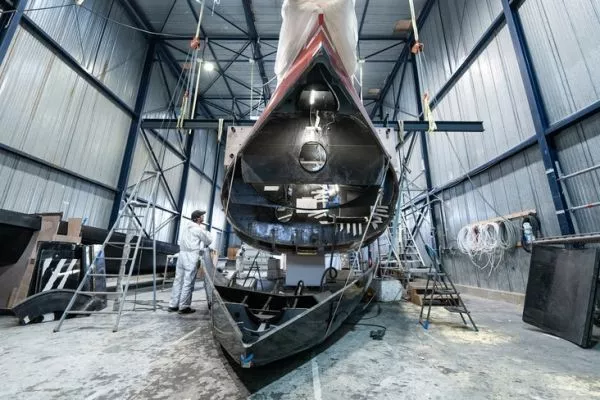 Charal 2’s Full Hull-Bottom Replacement and Single-Handed Performance Upgrade">

Logistics of a full-length hull surgery: cranes, permits and precision jigs
The Charal 2 refit involved cutting away the entire hull bottom along the monohull’s length and transporting two prebuilt composite half-hulls from Gepeto Composite to Charal’s base, a process that required heavy-lift cranes, road permits for oversized loads and alignment jigs that guarantee millimetric join tolerances. Such work turned a nautical engineering decision into a complex transport and workshop operation, where timing between design delivery and on-site assembly was critical to meet the June relaunch window ahead of the Route du Rhum.
Why the radical solution was chosen
After observing extended periods of flat, high-speed flight in race logs, the technical team around skipper Jeremie Beyou na tervező VPLP opted to replace the lower hull to reduce hydrodynamic drag in stabilized flight. The original scow-type hull produced power when heeled, but data showed Charal 2 sails more often flat than expected. The refit is intended to favour Kụyị́lị and low-drag characteristics at speeds above ၁၅ နော့, even if that implies accepting a modest loss of heeling-derived power.
Design partners and structural scope
The project paired VPLP’s hull redesigns with structural checks from Gurit, who previously worked on the boat’s initial structure. New half-hulls were manufactured by Gepeto Composite adjacent to Charal’s base to simplify logistics. This close coordination reduced transport risk and allowed mock-ups to be validated before high-stakes cutting of the carbon hull began.
Operation timeline and workshop workflow
- Winter 2024: conceptual redesign and structural assessment.
- Pre-assembly: manufacture of new half-hulls at Gepeto Composite.
- Mid-December: controlled cutting of the existing hull, exposing the internal framework.
- Spring: composite assembly and reintegration of mechanical, hydraulic and electronic systems.
- June: targeted relaunch, providing a roughly six-month test window before the Route du Rhum.
How the cut-and-replace was executed
Once the hull was opened, technicians rebuilt internal floors, bulkheads and beds to match the new geometry. Each fitting used precision templates; tolerances were reduced to the millimetre because any misalignment would alter foil angles, weight distribution and handling. After composite bonding, all systems—rudders, hydraulics and flight-control electronics—were reinstalled and calibrated to the revised hull shape.
Key technical challenges
- Alignment: ensuring longitudinal and transverse axes match new hull molds.
- Rigidity: preserving overall stiffness despite a radically changed bottom shape.
- Systems reintegration: routing hydraulics and electronics to suit altered internal layouts.
- Sea trials scheduling: validating changes under single-handed conditions before major races.
Expected on-water gains and implications for single-handed racing
The refit targets higher average speeds in fast gaits and improved performance in light airs—phases where Charal 2 was previously disadvantaged. Designers expect better acceleration into and out of foiling modes, smoother glide at stabilized speeds above 15 knots, and a more forgiving behaviour for single-handed operation. Past results suggested the boat’s peak potential was easier to reach with crewed or double-handed sailors; this intervention aims to close that gap for solo campaigns such as the Vendée Globe and the Route du Rhum.
| Parameter | Pre-refit | Post-refit (target) |
|---|---|---|
| Top sustained speed in flight | High but inconsistent | Higher stability above 15 knots |
| Light-air acceleration | Average | Improved due to lower drag |
| Single-handed handling | Demanding, benefits from extra crew | More forgiving and easier to exploit |
Broader impacts on the sailing scene and tourism
Advances born in IMOCA campaigns often trickle down to cruising and charters: improved hull shapes and control systems can influence how racing innovations show up in performance cruising boats, exclusive yacht charters for events, and even charter fleets used for yacht parties or small-group cruise packages. For travellers seeking thrilling offshore experiences, watching technological evolution like Charal 2’s refit adds context to choices between traditional charter yachts and performance-oriented vessels available via specialised providers.
For travellers looking to sample modern offshore sailing, platforms such as GetExperience.com dọn dẹp hơn để đặt các chuyến thuê du thuyền đã được xác minh và các chuyến du ngoạn trên thuyền buồm được may đo; trang web hỗ trợ thanh toán an toàn bằng xác nhận chứng từ và cho phép yêu cầu các chuyến du ngoạn phù hợp với sở thích cụ thể, mang đến những trải nghiệm đầy cảm hứng từ các cuộc đua trong tầm tay của những người đam mê.
မိန်း.
Ọ dịghị ihe nọchiri anya ịkwọ ụgbọ mmiri nke aka mbụ: ọbụnadị nkọwa teknụzụ na nyocha kachasị mma enweghị ike dochie oge dị n'ime ụgbọ mmiri. GetExperience na-enye njem ụgbọ mmiri dị iche iche gburugburu ụwa iji dabara mmasị na mmefu ego ọ bụla, na-eme ka ọ dị mfe ịnwale ụgbọ mmiri dị iche iche ma mụta ihe kachasị gị mma. Na GetExperience, ị na-edebanye ahụmahụ gị site na ndị na-eweta ihe nyocha na ọnụahịa ezi uche dị na ya; nke a na-enyere nhọrọ ka mma na-enweghị mmefu na mmechuihu na-enweghị isi. Rite uru na ndenye aha doro anya, ịkwụ ụgwọ echekwara, nkwenye vaucha na nhọrọ ịrịọ njem nlegharị anya emebere—Debanye njem gị GetExperience.com
Gbogboniṣe, àtúngbẹ̀dẹ hull-ìsàlẹ̀ Charal 2 jẹ́ aṣekáṣáárí ẹ̀rọ àti logistics ọ̀tọ̀tọ̀ tí a ṣe láti gbé glide lárugẹ, dín hydrodynamic drag kù, kí ó sì jẹ́ kí ìgbádùn-ọkọ̀ ojú omi ẹ̀dá kan ṣoṣo ní ìgbésísùn gíga rọrùn. Iṣẹ́ yìí gbà láti ìgbésẹ̀ oníṣeẹ́, ìṣelọ́jà àti àpéjọ́ àwọn ilé-iṣẹ́ ẹ̀rọ tí ó péye, ó sì yẹ kí ó mú èrè wá ní àwọn ọ̀nà ìgbésísùn yára àti afẹ́fẹ́ rírọ́. Fún àwọn arìnrìn-àjò àti àwọn olólùfẹ́ ìgbádùn-ọkọ̀ ojú omi, ìdàgbàsókè yìí sopọ̀ mọ́ ìrírí ìrìn-àjò tí ó gbòòrò jùlọ—láti àwọn àjọ̀kájọ̀kú ohun-ìní olówó gógó àti àwọn okòwò ìrìn-àjò láti àwọn ìgbòkègbodò eré ìdárayá bí àwọn ayẹyẹ ohun-ìní àti àwọn safari ẹranko ìgbẹ́ tí ó dára fún àyíká—nígbàtí ó sì ń bá ìfẹ́ nínú àwọn ìrìn-àjò ilé ọnà tí ó ní àwọn olùdarí alààyè tàbí àwọn oníṣe àjọṣepọ̀ àwọn ilé-iṣẹ́ kíkọ́ni lórí ínternẹ́ẹ̀tì tí ó ṣàlàyé ẹ̀dá tuntun ti ìgbádùn-ọkọ̀ ojú omi. Nígbẹ̀yìngbẹ́yín, àtúntò yìí ṣe àpẹẹrẹ bí tech eré ìje gíga ṣe ń fún àwọn àṣeyọrí tí ó ṣeé múlò nínú ìrírí ìrìn-àjò olówó gógó àti àwọn ìrìn-àjò eré ìdárayá tí ó rọrùn fún àwọn olùbẹ̀rẹ̀ pàápàá.