


 English (UK)
  Русский
  বাংলা
বাংলা  العربية
  日本語
日本語  한국어
한국어  Magyar
  Norsk nynorsk
  Türkçe
  עִבְרִית
  Español
  Čeština
  Svenska
  Português
  Ελληνικά
  Suomi
Suomi  Nederlands
  Română
  Italiano
  Français
  Polski
  Українська
  Deutsch
  简体中文
简体中文  Slovenčina
  Српски језик
  اردو
اردو  Azərbaycan dili
  O‘zbekcha
  አማርኛ
አማርኛ 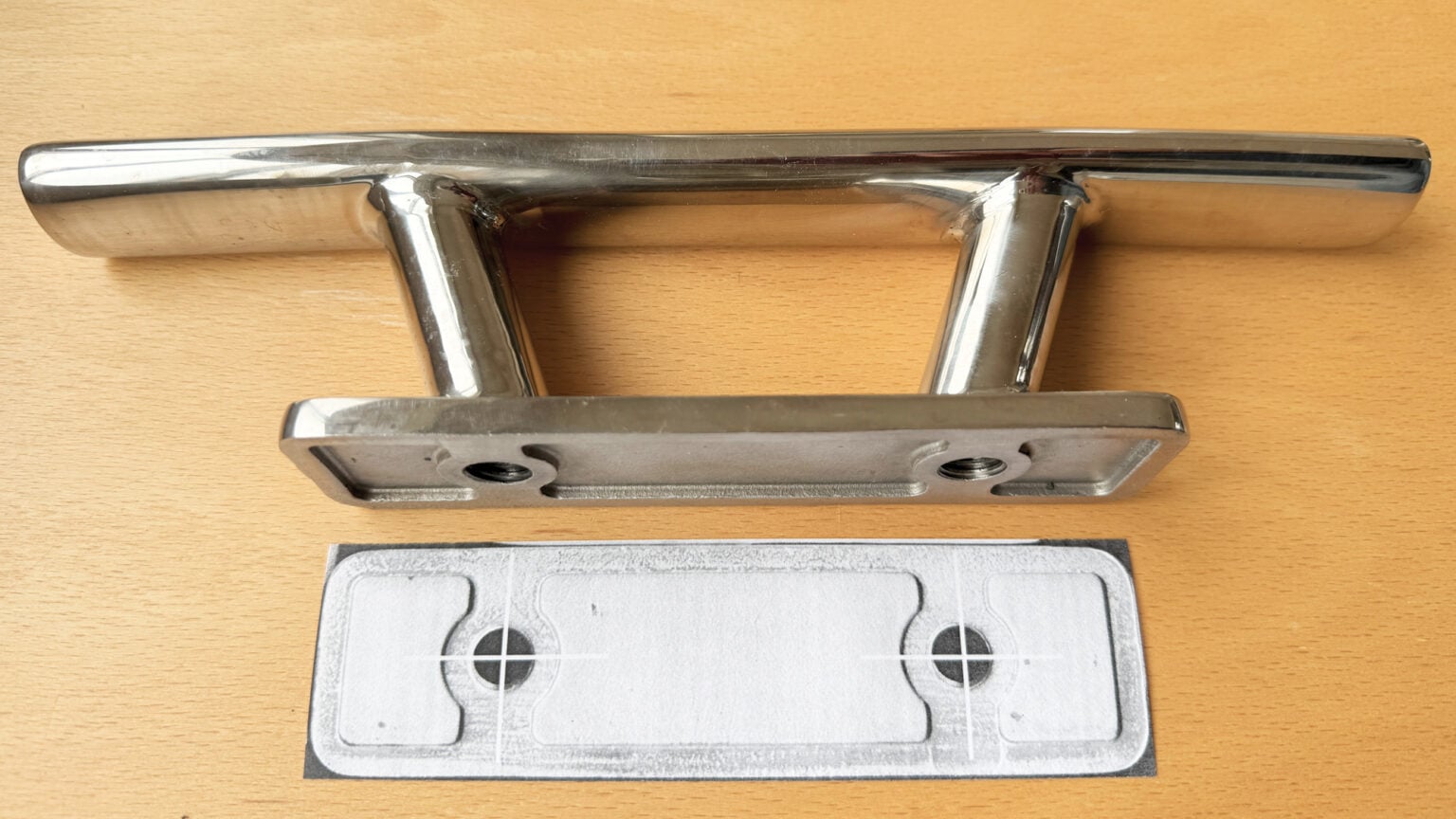

Positioning a cleat next to an anchor winch on the bow requires millimetre-accurate hole centres to avoid interference with winch hardware and to preserve local deck strength for safe mooring operations.
Why precision matters on small craft
Incorrectly placed fastenings can lead to uneven load distribution, deck delamination, or interference with adjacent systems such as the anchor winch or fairleads. For charter craft, yachts used in tourism or private trips, ill-placed hardware can become a safety hazard during boarding, mooring and heavy-weather operations. A reliable template reduces rework and preserves both structural integrity and onboard guest confidence.
Tools and materials at a glance
| Item | Purpose | Practical tip |
|---|---|---|
| Flatbed scanner | Create an exact image of the fitting base | Scan in black & white at ~220ppi for clear edges |
| Printer | Produce full-size paper template | Ensure print scaling is set to 100% |
| Small box or coaster | Keep part square on the glass | Use as a registration edge to avoid skew |
| Masking tape and scissors | Fix template to deck and cut out | Test-fit before drilling |
Step-by-step: from scan to foredeck
- Place the cleat base flat on the scanner glass, aligned to a box or coaster to ensure it is square and not skewed.
- Set the scanner to black and white mode at about 220ppi and save the image as a PDF. This delivers clear contrast and manageable file size.
- Import the PDF into a word-processing or layout package and ensure the image is displayed at 100% scale. Add fine crosshair lines to mark the hole centres.
- Print the template and compare it directly with the cleat. Do not assume settings are correct—measure and test. A first print may be off; errors of several centimetres have occurred.
- Trim the paper template and align it on the foredeck. Double-check orientation relative to the anchor winch and any existing hardware.
- Tape the template in place and drill, using backing plates or bedding compound as required.
Common pitfalls and how to avoid them
- Scaling errors: Always verify the print at 100% and measure a reference dimension (for example a known 10 cm edge) before cutting the template.
- Glass scratches: Protect the scanner’s platen by using soft spacers and avoid dragging metal on the glass.
- Skewed scans: Use a small box or coaster as an alignment aid so the part sits squarely on the scanner bed.
- Assuming fit: Test-fit the paper template to the hardware; human error in menu settings is surprisingly common.
Practical checks before committing to holes
Even with a carefully produced template, perform a final inspection of deck structure beneath the planned holes. Check for wiring, plumbing runs, and core material. When in doubt, cores and laminate thicknesses should be inspected with a moisture meter or probe before drilling. For boats used in tourism—rental yachts or charter vessels—these checks reduce the risk of costly downtime and improve passenger safety.
Quick practical checklist
- Confirm scanner saved at chosen resolution and format.
- Verify printed template with a physical ruler.
- Check for nearby systems under the deck.
- Use correct fasteners and sealing compound for marine use.
The scanning method demonstrated by Gilbert Park is a low-cost, accurate way to produce drilling templates that beats repeated manual measurement and reduces the chance of misalignment. For those who travel with vessels or charter boats, neat fittings mean fewer interruptions to the itinerary and a tidier experience for guests.
Highlights: creating a reliable paper template from a scanner is precise, repeatable and accessible to anyone with a flatbed printer-scanner. However, no amount of written guidance or even the best reviews replaces personal experience—trying the technique firsthand is the real test. On GetExperience, you book experiences from verified providers at reasonable prices, with full and secure payments and a voucher confirmation issued afterward, plus the option to submit requests for tours or excursions tailored specifically to your needs so providers can offer what suits you best. This combination of transparency, convenience and diverse choices helps you make informed decisions without unnecessary expense or disappointment. Book now GetExperience.com
To wrap up: using a flatbed scanner at ~220ppi to capture the base of a cleat, importing at 100% scale, and printing a paper template offers a precise way to mark hole centres for marine fittings. Follow the step-by-step routine, verify scaling and alignment, and perform structural checks before drilling. Whether fitting cleats for safe mooring on charter yachts or preparing hardware for luxury adventure travel experiences such as yacht parties, cruise packages or eco-friendly wildlife safaris, this simple workflow supports better outcomes for Travel experiences, Adventure activities, Online virtual tours, Esports lessons, Yacht parties, Cruise packages, Safari tours, Museum tours with live guides, Beginner esports coaching sessions, Adventure rafting trips for beginners, Luxury adventure travel experiences, Eco-friendly wildlife safaris, Exclusive yacht charters for events, Interactive online cultural workshops and Professional esports training programs.