


 עִבְרִית
  English (UK)
  Русский
  বাংলা
বাংলা  العربية
  日本語
日本語  한국어
한국어  Magyar
  Norsk nynorsk
  Türkçe
  Español
  Čeština
  Svenska
  Português
  Ελληνικά
  Suomi
Suomi  Nederlands
  Română
  Italiano
  Français
  Polski
  Українська
  Deutsch
  简体中文
简体中文  Slovenčina
  Српски језик
  اردو
اردو  Azərbaycan dili
  O‘zbekcha
  አማርኛ
አማርኛ 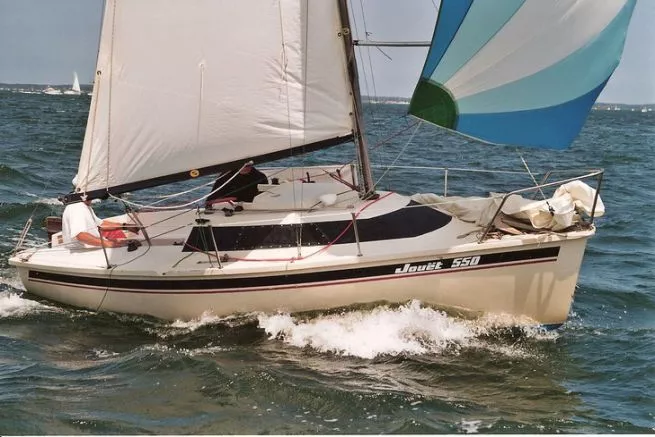 שיט תענוגות קומפקטי: Jouët 550 - ביצועים חופיים ושימושיות פרקטית">

Launch logistics and coastal suitability at a glance
On tidal ramps and small marinas the Jouët 550 proves highly practical: its 550 kg all-up displacement and flat hull allow launching and recovery by standard trailer winch, while the 85 kg cast-iron keel and lifting daggerboard require attention during handling and storage. These figures make the 5.50 m micro-sloop suitable for bays and estuaries with shallow grounding and limited crane facilities.
Design, rig and sailing characteristics
The Jouët 550 was produced from 1979 to 1984, and its lines reflect a concise brief for a small, fast coastal boat. The deckhouse framed by a dark band remains a hallmark of its era, but the hull form—narrow waterline and low wetted surface—delivers lively performance in light airs. With around 18.5 m² upwind sail area the boat accelerates quickly and responds well to a lightweight crew.
Performance notes
- Upwind: efficient and stiff enough to keep pace with peers when trimmed; the slender profile favors pointing and speed through chop.
- Downwind: the model happily flies a spinnaker and glides when breezes build—its planing tendencies appear early.
- Light-air advantage: minimal wetted surface and elongated overhangs help the boat stay lively in sea-breeze conditions.
Variants and rigging
The rare “S” version, fitted with an additional 80 cm of mast height, offers increased sail power; it is uncommon but notably punchier in moderate winds. Most examples remain in standard configuration and are straightforward to maintain.
Accommodation and onboard practicality
Below deck, the Jouët 550 offers compact but usable space: two side single berths and a forward double give four sleeping places, while the cabin headroom peaks at around 1.20 m, sufficient for seated comfort. Some later-fit models include a kitchenette or small chart table, but factory fit-out was intentionally minimal to keep costs and weight down.
Practical checklist for buyers
- Inspect the daggerboard trunk for wear and internal abrasion from the keel.
- Check the cast-iron keel for rust and secure mounting—lifting loads can exacerbate hull-keel interface issues.
- Examine chainplates, bow fittings and stay anchorage for corrosion or elongation.
- Confirm the condition of the internal ballast arrangement and battery well placement.
| מפרט | ערך |
|---|---|
| אורך כולל | 5.50 m |
| Upwind sail area | 18.5 m² |
| Displacement (all-up) | 550 kg |
| Keel weight | 85 kg (cast iron) |
| Production years | 1979–1984 (approx. 154 built) |
Strengths and limitations
The Jouët 550 scores highly for performance relative to cost, trailerability and the ability to ground safely in shallow water—practical advantages for coastal cruisers and sailing schools operating in tidal areas. However, the minimalist factory finish means that many boats lack cockpit lockers and an external anchor locker; retrofit work is common to improve stowage and modernise fittings.
- יתרונות: excellent acceleration, contemporary styling for its era, and ability to ground in as little as 30 cm.
- Disadvantages: sparse factory fit-out, limited keel stability noted on some examples, and non-removable daggerbox/appendage integration complicates repairs.
Alternatives and modern equivalents
With the Go 550 and Squid out of production, similar options are limited. Close contemporary analogues include the Junior iKone (sloop version), the Blue Djinn and a few Polish designs such as the TES 550. For buyers seeking a similar programme—day sailing, coastal cruising and small-regatta use—these are sensible comparisons.
Tourism angle: why sailors and day-trippers should take note
For coastal tourism operators and independent charterers, the Jouët 550’s trailerability and shallow-draft capability make it an attractive platform for short excursions, photography trips and basic sailing lessons. It is compact enough for economical maintenance yet sporty enough to appeal to guests looking for authentic sailing experiences rather than luxury amenities.
Booking coastal trips, museum-harbour tours with live guides or yacht parties that prioritise sailing feel over onboard frills can benefit from affordable micro-cruisers like the Jouët 550. Platforms such as GetExperience.com allow organisers and guests to arrange secure payments with voucher confirmations and to request tailored excursions that match vessel capabilities and guest preferences.
Highlights: the Jouët 550 remains an interesting micro-cruiser for people who value performance, easy launching and low-cost ownership. Still, no catalogue entry or online review replaces time aboard—firsthand experience is decisive. On GetExperience, you book your experience from verified providers at reasonable prices. This empowers you to make the most informed decision about excursions and sailing lessons without unnecessary expenses or disappointments; the platform also accepts secure online payments and enables customised tour requests so providers can offer the best match for your needs. Book now GetExperience.com
In summary, the Jouët 550 blends lightweight performance with trailer-friendly logistics, making it ideal for coastal day trips, basic regattas and entry-level cruising. Its main trade-offs are simple factory fit-out and the technicalities of a non-removable daggerbox and cast keel—factors worth checking for prospective buyers. Whether you seek travel experiences, adventure activities or small yacht charters, consider hands-on trials and local offerings such as museum tours with live guides, cruise packages, yacht parties or eco-friendly wildlife safaris to test what works best for your plans; online virtual tours, interactive online cultural workshops and even professional esports training programs now sit alongside more traditional options like safari tours and adventure rafting trips for beginners when planning a trip. The Jouët 550 remains a practical choice for enthusiasts pursuing affordable, hands-on sailing and luxury adventure travel experiences alike.