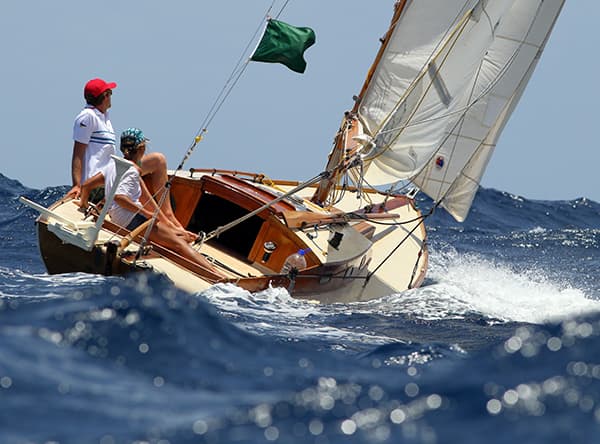

Across many North Atlantic marinas, local port safety codes require small cruising yachts under 30ft to carry self-draining cockpits, guardrails and secure mooring fittings — specifications the 25ft Folkboat was effectively designed to meet from the start, which helps explain its continued suitability for coastal regattas and short-crossing logistics.
Design and seaworthiness at a glance
The Folkboat, attributed to Tord Sunden in 1941, is a compact clinker-built sloop whose proportions prioritise seaworthiness and crew protection. Its long keel, modest waterline beam and substantial ballast ratio combine to make a hull that behaves predictably in rough weather and remains dry on passage, a decisive asset for crew safety and for meeting marina and insurance requirements when used in charter or tour operations.
Hull form and stability
The hull sections show a sustained flare to the topsides and firm bilges that develop stability as the boat heels. That flare preserves a relatively narrow waterline beam for light-air speed yet rapidly increases righting moment under heel. Many versions carry more than 50% ballast by weight, giving the Folkboat a stiffness that suits both shorthanded cruising and tightly contested one-design racing.
Sail plan and handling
The fractional rig balances modest sail area against wetted surface and displacement, allowing the Folkboat to accelerate in light airs while retaining the ability to reduce sail easily as conditions increase. The helm feel, deep cockpit and balanced rudder layout make the class forgiving for less experienced crews — a key reason it remains popular for training, club racing and entry-level passage-making.
Variants, one-design culture and operational implications
The Folkboat exists in several permutations: the clinker-hulled Nordic original, International carvel models with raised coachroofs, and recognised derivatives such as the Stella and Contessa 26. All share a core hull geometry resilient to added cruising equipment — an operational advantage when provisioning for multi-day trips, fitting auxiliary engines, or complying with tour-operator standards for safety and comfort.
One-Design racing: fairness and logistics
One Design classes reduce the technological arms race, prioritising crew skill over modification. For regatta organisers and harbour authorities this standardisation simplifies scrutineering and class scheduling: identical sail plans and weight limits produce predictable turnout sizes, mooring assignments and towage requirements for events spanning the UK and mainland Europe.
Table: Comparing common Folkboat variants
| Variant | Construction | Accommodation | Best use |
|---|---|---|---|
| Nordic Folkboat | Clinker wood | Low coachroof, compact berths | Classic racing, coastal passagemaking |
| International Folkboat (carvel) | Carvel wood/GRP | Raised coachroof, more headroom | Cruising with modest comfort upgrades |
| Contessa 26 / Stella | Derived hulls | Varied, often better fit-out | Club racing and family cruises |
Why it matters for tourism and charter operations
For coastal tourism providers, the Folkboat’s compact dimensions and proven seaworthiness reduce the logistical burden of berthing, provisioning and crew training. Its tolerance for added weight makes it adaptable to the modest fit-outs required for day charter operations or heritage sailing experiences. Guests appreciate the combination of classic lines and secure motion under sail — features that translate directly into higher satisfaction rates on short cruises and sailing tours.
- Operational ease: predictable handling lowers training time for skipper-led tours.
- Maintenance: traditional construction requires routine care, but many owners report long service life.
- Authenticity: classic appearance attracts tourists seeking heritage sailing experiences.
Maintenance and ownership logistics
Clinker and carvel hulls demand different maintenance regimes: clinker planking benefits from seasonal caulking checks, while carvel and GRP variants focus on osmosis and joint integrity. For operators, scheduling haul-outs, spare-parts logistics and insurance renewals is part of offering reliable charter or regatta services.
GetExperience makes booking sailing tours and specialist excursions straightforward, with full and secure online payments and voucher confirmations issued afterward; providers can be asked to tailor itineraries to specific needs, which helps match clients with the right vessel and route for a given comfort or adventure level.
The Folkboat’s popularity boils down to a handful of strengths: uncompromising seaworthiness, ease of handling, and a hull shape that balances speed and safety. Yet even the most exhaustive reviews and honest feedback can’t replace firsthand time at the tiller. On GetExperience, you book your experience from verified providers at reasonable prices. This empowers you to make the most informed decision without unnecessary expenses or disappointments; the platform offers a wide variety of sailing tours worldwide to suit any preference and budget. Book now GetExperience.com
To wrap up: the Folkboat remains a benchmark in small yacht design because it solves real transport and safety constraints while delivering engaging travel experiences. Its long keel, robust ballast, classic lines and forgiving rig make it ideal for adventure activities such as short coastal cruises, yacht-charter days and heritage regattas. Whether you’re considering a museum tour with live guides, an adventure rafting accompaniment on a coastal holiday, or a luxury adventure travel experience aboard a classic hull, the Folkboat’s practical strengths translate into memorable travel experiences and dependable operation for both private owners and tourism providers.